

31 Holy Sites In Jerusalem Not To Miss In 2026 (With Map)
According to both the Hebrew and Christian Bible, King David conquered Jerusalem in 1,000 B.C. and made it the capital of the Jewish kingdom. (2 Samuel 5:4-9)
Since that time, Jerusalem has been attacked 52 times, captured and recaptured 44 times, besieged 23 times, and destroyed twice.
In the midst of all that, Jerusalem became the location of the holiest sites of the world’s 3 major religions – Judaism, Christianity, and Islam. This includes the Temple Mount, Western Wall, Mount of Olives, Garden of Gethsemane, Via Dolorosa, and the Dome of the Rock.
I first went to Jerusalem in 2018 as part of a two week tour of Israel tour with my church. I stayed after a few days to explore the city on my own, and have been studying it ever since.
In this post I will tell you the history and spiritual significance of every Holy Site in Jerusalem. And insider tips on how to visit them.

Plan Your Trip With My Favorite Resources
– Best Accommodations: Booking.com
– Top Day Tours: Viator.com
– Purchase Travel Insurance: SafetyWing

Holy Sites In Jerusalem
Judaism, Christianity, and Islam all have holy sites in Jerusalem that they consider central to their faith.
The Temple Mount and Western Wall are considered the holiest sites in Judaism. And several major Christian events took place in Jerusalem, including the Last Supper, Palm Sunday, the Garden of Gethsemane, and Jesus’ death and resurrection. And lastly, the Dome of the Rock/Al-Aqsa Mosque complex is the third holiest sites in Islam.
Travel Tip! You should dress conservatively at the holy sites in Jerusalem out of reverence. Some have dress codes. For example, visitors are only allowed to enter the Temple Mount (the site of the Dome on the Rock and Al-Aqsa Mosque) if their arms and legs are covered.
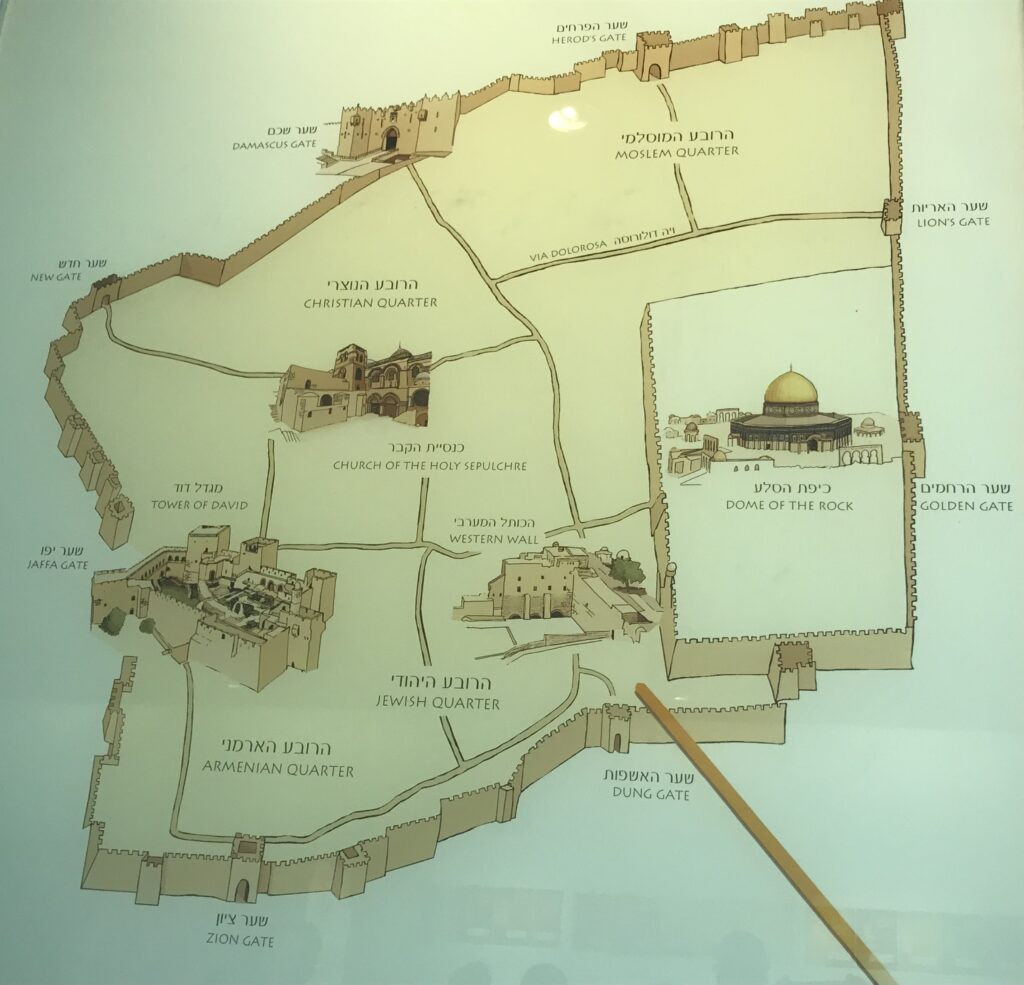
Jewish Holy Sites in Jerusalem
Jerusalem is the most sacred city in Judaism.
The word Jerusalem is mentioned in the Tanakh (Hebrew Bible) 669 times. And the word Zion – which usually means Jerusalem – is mentioned 154 times. (In contrast, the word Jerusalem is mentioned in the Bible 806 times and it is not mentioned once in the Koran).
The holiest Jewish site in the world is the Temple Mount in Jerusalem. However, the site is currently run by a Muslim organization and Jews are not allowed to pray there.

1) Temple Mount
The Temple Mount (Har HaBayit in Hebrew) is the holiest site in Judaism. It has a long and storied history documented by both the Torah and the Bible.
In 1,000 B.C. King David conquered Jerusalem and made it the capital of the Jewish kingdom. (2 Samuel 5:4-9) At the time, the Ark of the Covenant was being kept in a tent. King David wanted to build a temple for the ark. (II Samuel 7:1-2) However, God told David that he had shed too much blood to build the temple. (1 Chronicles 22:8)
Then in 957 B.C. King David’s son Solomon built the First Temple on Mount Moriah. (2 Chronicles 3:1) It was bult at the exact place where Abraham was tested by God to sacrifice his only son Isaac! (Genesis 22:1-8)
Both the First and Second Temples were built over the Foundation Stone, which is where Jews believe that God created the world.

The Second Temple
In 587 B.C., the Babylonians occupied Jerusalem, destroyed the Temple, and sent the Jews into exile. When the Jewish exiles returned 60 years later, they constructed a modest temple. (Ezra 3:8-13) Then around 20 B.C. King Herod fully renovated and massively enlarged the Second Temple. (John 2:20)
In response to a Jewish revolt in A.D. 70., Roman soldiers destroyed the Second Temple. The only thing left standing was the Western Wall.

The Temple Mount Today
Fast forward to 635 A.D. Muslim Caliph Omar – who was the second successor to the prophet Muhammad – conquered Jerusalem. Fifty years later two Muslim holy sites – the Dome of the Rock and the Al-Aqsa Mosque – were built ON TOP of the Temple Mount,
That makes for a complex situation. The Temple Mount complex is currently under Israeli sovereignty. However, it has been administered by the Jerusalem Islamic Waqf since Saladin regained Jerusalem in 1187. (A waqf is a charitable trust recognized by Islamic law).
Non-Muslims are not allowed to enter the Dome of the Rock or the Al-Aqsa Mosque. The Temple Mount is only open to non-Muslims – including Jews – for 4 hours each day. 3 hours in the morning and 1 hour after lunch. In addition, non-Muslims are not permitted to pray on the Temple Mount, bring prayer books, or wear religious apparel.
Therefore, Jews are not allowed to pray on the Temple Mount despite it being their holiest site. And Jewish sacred objects such as prayer books and tallit are not allowed on it. I once saw a Jewish man get taken away by security for trying to pray on the mount.
In addition, Christian prayers and religious items are also not allowed on the Temple Mount. I was asked to hide my cross necklace – which I always wear – under my shirt.

How to Visit Temple Mount
There are 12 gates surrounding Temple Mount. However, only Muslims are allowed to use 11 of the gates.
If a non-Muslim wants to visit Temple Mount, they have to go to the Western Wall Plaza and walk across a wooden bridge called the Mughrabi Bridge. (Picture below). It leads to the Mughrabi (Moroccan) Gate, which is the only 1 of the 12 gates surrounding the Temple Mount that non-Muslims are allowed to enter.
The Temple Mount is closed to visitors on Fridays and Saturdays. The opening hours are listed below. Entrance to the site may be closed without notice for security reasons. Since it is only open for a few hours at a time, there are usually long lines. So get there early.
Visitors to the Temple Mount have to cover their arms and legs. If you are not covered enough, waqf workers will provide clothing to slip on over your clothes.
For example, I once went to the Temple Mount wearing shorts and I was given a turquoise full length skirt to put on over my clothes. It did not match the outfit I was wearing and my pictures looked terrible. Therefore, I highly recommend that you think about your outfit in advance.
Once you enter Temple Mount, there are a lot of things to explore. There are over 100 different structures spanning several different time periods. including prayer locations, arches, and fountains.

Temple Mount
Opening Hours: Sunday-Thursday 7:30am-10:30am & 1:30pm-2:30pm (Summer) / 7:00am-10:30am & 12:30pm-1:30pm (Winter). Closed on Fridays, Saturdays, and Muslim/Jewish holidays.
Cost: Free
Location: Temple Mount, Old City
➡️ Explore Guided Tours For the Dome of the Rock & Temple Mount
2) The Western Wall
When the Romans destroyed the Second Temple in 70 A.D. the only thing they left standing was the Western Wall. (Note that Jewish people don’t like calling it the Wailing Wall).
The Roman soldiers decided not to destroy the limestone wall because it was so massive it would have been difficult to destroy. They could never have imagined the result of their action!
The wall was located near the “the Holy of Holies”, which is the most sacred part of the temple. Both the Torah and the Old Testament claim that the Lord’s presence shall never depart from that spot.

How to Visit the Western Wall
The Western Wall is now considered one of the holiest sites in Judaism. Jews and Christians come from all over the world to pray there. The Western Wall Plaza hosts thousands of worshippers and visitors daily.
The Western Wall is located in the southeast corner of the Old City of Jerusalem. It is in the Jewish Quarter, next to both the Christian Quarter and the Temple Mount. The closest gate is the Dung Gate. The wall can be accessed by car, bus, or foot. Bus #1, #3, and #38 have stops near the entrance.
Volunteers are on site to pass out small pieces of paper that visitors can write their prayer requests on and place in the cracks of the wall. Every year over 1 million pray requests are places in the wall’s crevices, which staff collect to make space for other visitors.
The Western Wall serves as a central venue of Jewish life and culture, hosting celebrations, memorials, and Jewish national ceremonies.

The Western Wall
Opening Hours: Open 24/7
Cost: Free
Location: Western Wall Plaza, Southeast corner Old City in Jewish Quarter.
3) King David’s Tomb
According to Jewish, Christian, and Muslim tradition, King David’s Tomb is located on Mount Zion. It occupies the ground floor of a building that later became a Crusader church.
The upper floor of the building houses the Cenacle or Upper Room, which is the site of Jesus’ Last Supper with his disciples.
However, historians, archaeologists and Jewish religious authorities don’t think this is the correct location. I was so sad to learn this, because I really wanted it to be true.
According to 1 Kings 2:10, when David died he “slept with his ancestors” and was buried in the City of David.
King David’s Tomb is open from 8:00am to Sunset. It’s free and you don’t need a reservation. There are separate entrances for men and women. The main attraction is the tomb, which is located in a room covered with Jewish symbols and a draped sarcophagus.

King David’s Tomb
Opening Hours: 8:00am-Sunset
Cost: Free
Location: Mount Zion
4) The Golden Gate (Jewish Tradition)
Between 1537-1542, Ottoman Sultan Suleiman the Magnificent constructed walls around Jerusalem’s Old City. The walls contained 34 towers and 11 gates; 7 of the gates are currently open.
The Golden Gate is adjacent to the Temple Mount / Al-Aqsa Mosque compound. The only gate located near the Mount of Olives, Jews consider the gate a holy place.
Ancient Jews entered Jerusalem through the Golden Gate for the most direct access to the Jewish Temple. When Jews were denied access to the Temple during the Crusader period (1099-1187), they would go to the gate to pray and ask for mercy. Therefore, Jews call it the Gate of Mercy.
According to Jewish tradition, on Yom Kippur (Day of Atonement) a messenger was sent through the gate from the Temple to the desert with a sacrificial lamb. And more importantly, Jews believe the Messiah will enter Jerusalem through the Eastern Gate and the dead will be resurrected!
In addition, Christians and Muslims also consider the Golden Gate a holy site. Christians believe on Palm Sunday Jesus triumphantly entered Jerusalem through the Golden Gate riding a donkey. And he will return through the gate just like how he left.
And Muslims believe that on the Last Day the righteous will pass into paradise through the Golden Gate.

Check out my blog The 8 Gates of Jerusalem: History, Facts, Pictures!
The Golden Gate
Opening Hours: Can visit outside the gate 24/7
Cost: Free
Location: Eastern wall of the Old City
5) Mount of Olives Jewish Cemetery
The Mount of Olives Jewish Cemetery is the oldest and most important Jewish cemetery in the world. Burial records date back over 3,000 years.
It is the final resting place for over 150,000 souls including many notable Jewish figures. This includes prophets, rabbis, and leaders, such as the Prophet Zachariah and several of King David’s sons.
The cemetery is open from dawn to dusk. You will notice there are a lot of rocks on the tombs. As part of Jewish bereavement practices small stones are placed by visitors as an act of remembrance or respect for the deceased.

Mount of Olives Prophecy
Both Jews and Christians believe that when the Messiah comes people who are buried at the Mount of Olives will be resurrected first. This is stated in Zechariah 14:4 which is found in both the Hebrew Bible (Tanakh) and the Old Testament of the Bible.
Furthermore, in Acts 1:9-11 Jesus was raptured to heaven from the Mount of Olives and an angel told his followers that he would return that way.
As a result, both Jews and Christians want to be buried at the Mount of Olives Cemetery and it costs a minimum of $30,000 to be buried there! In addition, bodies are buried with their feet facing the Temple Mount so they can simply rise and walk straight to the Temple.

Mount of Olives Jewish Cemetery
Opening Hours: Dawn to Dusk
Cost: Free
Location: Mount of Olives
Christian Holy Sites in Jerusalem
Jerusalem is one of the most holy cities in Christianity. It has a special place in the hearts of Christians, because it is the site of numerous biblical accounts.
The word Jerusalem is mentioned in the Bible 806 times – 660 times in the Old Testament and 146 times in the New Testament. And the synonym Zion is mentioned in the Old Testament 158 times and in the New Testament 7 times.
In contrast, the word Jerusalem is mentioned in the Jewish Torah 669 times and is not mentioned once in the Koran.

Biblical Events that took place in Jerusalem
- Starting at age 12, Jesus taught in the Temple
- Jesus healed a paralyzed man at the Pool of Bethesda
- On Palm Sunday Jesus rode a donkey down the Mount of Olives to Jerusalem
- The Last Supper took place in the Upper Room on Mount Zion
- Jesus was betrayed in the Garden of Gethsemane
- Jesus was crucified outside of Jerusalem’s Old City Walls
- Jesus ascended into heaven on the Mount of Olives 40 days after his death
- The Day of Pentecost took place in the Upper Room on Mount Zion

6) Church of the Holy Sepulchre
The holiest Christian site in the world is the Church of the Holy Sepulchre.
According to tradition, the church is located on the site where Jesus was crucified, buried, and resurrected. (The altar was built on the place where Jesus was crucified. And the dome was constructed over the place where Jesus was buried and resurrected).
Because of this, the Church of the Holy Sepulchre is the location of the final 5 Stations (Stops 10-14) of the Via Dolorosa, which is the route that Jesus took to his death.
However, Evangelical Christians such as myself believe that Jesus was crucified outside the city walls at the Garden Tomb.

Discovered by Emperor Constantine’s Mother Helena
In 326 A.D. Roman Emperor Constantine sent his mother Helena to the Holy Land to search for Christian relics.
While in Jerusalem, Helena found 3 crosses near a tomb. She thought that she had found the place where Jesus was crucified.
The site was originally a Jewish burial ground and later a Roman temple. After Helena’s discovery, Emperor Constantine built a church and rotunda on top of the temple.
The church then changed hands several times. It was burned by the Persians in 614, restored by an abbot from 616–626, destroyed by a Muslim caliph in 1009, then restored by a Byzantine emperor. In the 12th century the Crusaders rebuilt the church. The present church dates mainly from 1810.

Stone of Anointing
When you enter the Church of the Holy Sepulchre, the first thing you will see if you keep walking straight is the Stone of Anointing.
All 4 gospels record that Joseph of Arimathea asked Pilate for Jesus’ body and prepared it for burial. And John tells us in his gospel that Nicodemus also helped prepare the body. (Matthew 27:57-60) (Mark 15:43-46) (Luke 23 :50-53) (John 19:38-42)
According to tradition, Joseph and Nicodemus prepared Jesus’ body for burial on top of the Stone of Anointing. Pilgrims to the Church of the Holy Sepulchre pray on top of the stone.

Calvary/Golgotha
As soon as you walk into the Church of the Holy Sepulchre there is a staircase on your right that leads to Calvary (Golgotha). According to tradition, this is the exact location where Jesus was crucified.
There are 2 chapels with altars in this area – Greek Orthodox and Roman Catholic. In the Greek Orthodox chapel (located on the left/north side), the Altar of the Crucifixion is located on top of the Rock of Calvary. This is the 12th Station of the Via Dolorosa.
The Rock of Calvary is enclosed in glass. You can crawl underneath the altar and reach down and touch the rock.
The Roman Catholic Chapel of the Nailing of the Cross is located on the south side. It is the 11th Station of the Via Dolorosa. In between the two chapels is an 18th century bust of Mary which is the 13th Station of the Via Dolorosa.


Jesus’ Tomb
The most important thing to see at the Church of the Holy Sepulchre is Jesus’ tomb. It is located under the main rotunda in a 2-room chapel called the Aedicule.
Jesus’ tomb is formally known as the Holy Sepulchre. (A sepulchre is a tomb cut in rock where a deceased person is buried).
All 4 gospels tell us that Jesus’ tomb had a stone covering the entrance. (Matthew 27:59-60) (Mark 15:46) (Luke 24:2-3) (John 20:1) The first room of Aedicule chapel houses the Angel’s Stone, which is thought to be a fragment of the large stone that sealed Jesus’ tomb.
The second room of the Aedicule chapel houses Jesus’ tomb. You can go inside the tomb. Note! The line is usually really long.


Chapel of Saint Helena
The Chapel of Saint Helena is a 12th century Armenian church located in the lower level of the Church of the Holy Sepulchre. It was built on top of the spot where some Christians believe the True Cross of Jesus was found!
The chapel was constructed during the Crusader Kingdom of Jerusalem. The Armenians call it the Chapel of St. Gregory the Illuminator after the saint who brought Christianity to the Armenians.
The Chapel of Saint Helena is decorated with beautiful Armenian paintings and an amazing floor mosaic.

How to Visit the Church of the Holy Sepulchre
The Church of the Holy Sepulchre is located in the Christian Quarter of the Old City. It has been the main Christian pilgrimage site since the 4th century. Non-Christians also like to visit this famous place.
As a result, the church gets so crowded you can barely move. Therefore, I recommend getting there early (it opens daily from 4:00-5:000am) or late (it closes daily between 7:00-9:00pm).
Entry is free and no ticket is required. Check the latest opening hours before you go. If you want to attend mass, check out the schedule.
I usually like to explore famous sites on my own. However, there are so many rooms and so much history inside the Church of the Holy Sepulchre I recommend taking a tour.


The Status Quo
The Church of the Holy Sepulchre is not run by any one denomination. Instead, under an agreement known as the “Status Quo”, six different Christian denominations oversee the church.
It all started during the Great Schism between the Catholic and Orthodox churches in 1054. There was then infighting over the Christian holy sites in Jerusalem (and nearby Bethlehem) for several centuries.
Finally, in 1757 Ottoman Sultan Osman III issued a series of decrees regarding ownership and responsibilities of nine holy sites in Jerusalem and Bethlehem.
Then the decrees of 1852 and 1853 declared that no changes can be made to the sites without consensus from all six Christian denominations. This includes something as simple as moving a ladder!
The decrees received international recognition in the 1856 Treaty of Paris. And the term Status Quo was first used in the 1878 Treaty of Berlin.

The 9 Holy Sites that are Part of the Status Quo
- Chapel of the Ascension (Jerusalem)
- Chapel of the Milk Grotto (Bethlehem)
- Chapel of the Shepherd’s Field (Bethlehem)
- Church of the Holy Sepulchre (Jerusalem)
- Church of the Nativity (Bethlehem)
- David’s Tomb and Cenacle (Jerusalem)
- Rachel’s Tomb (Bethlehem)
- Tomb of the Virgin Mary (Jerusalem)
- Western Wall (Jerusalem)

Status Quo Denominations
As part of the Status Quo, 6 Christian denominations and several secular entities oversee the Church of the Holy Sepulchre. The different agreements have been in place for 160 years or more.
- Roman Catholic
- Greek Orthodox
- Armenian Apostolic
- Coptic
- Syriac
- Ethiopian Orthodox
Under the Status Quo the Orthodox, Roman Catholic, and Armenian Apostolic churches all have rights to Jesus’ Tomb. Each celebrates mass there daily.

The Immovable Ladder
The Immovable Ladder is the most famous ladder in the world! Technically, it is a wood ladder located under a second floor window of the Church of the Holy Sepulchre.
However, it is so much more! The ladder is a symbol of the Status Quo, an agreement among different religious communities to share 9 holy sites in Jerusalem and Bethlehem; including the Church of the Holy Sepulchre.
We don’t know when the ladder was placed there. The oldest known depiction of the ladder is in 1728.
The ladder is referred to as immovable due to the Status Quo decree that none of the 6 Christian denominations can move, rearrange, or alter any property without the consent of the other 5.
When my tour guide showed us the ladder he told us it cannot be moved unless all 6 denominations agree to it. I did not understand its significance at the time. So I’m glad that I took a picture of it!


The Muslim Doorkeepers
Incredibly, for over 800 years two Muslim clans have controlled some parts of the church.
In 1192 the Muslim Sultan Saladin gave the Muslim Nuseibeh family control of the main entrance. And in 1187 he made the Muslim Joudeh Al-Goudia family custodians of the keys to the church.

Church of the Holy Sepulchre
Opening Hours: 5:00am-9:00pm Summer (April-October) / 4:00am-7:00pm Winter (November-March). Closes at 8:00pm on Sundays year-round.
Days Closed: Open 365 days a year.
Cost: Free
Location: Saint Helena St in the Christian Quarter
➡️ Explore guided tours of the Church of the Holy Sepulchre here.
7) The Garden Tomb
Evangelical Christians such as myself believe that the Garden Tomb – not the Church of the Holy Sepulchre – is the site of Jesus’ crucifixion, burial, and resurrection.
It is located outside the city walls of Old Jerusalem, next to the Damascus Gate in the shadow of Skull Hill.
The Garden Tomb is thought to be Jesus’ tomb because – unlike the other tombs in the area – it has two rooms.
All 4 gospels tell us that Jesus had a “rolling stone tomb” which is two-room tomb that has a stone covering the entrance. The deceased’s body is located in the inner room; the outer room is a visiting area. (Matthew 27:59-60) (Mark 15:46) (Luke 24:2-3) (John 20:1)

You can go inside the Tomb of Jesus!
VISITORS TO THE GARDEN TOMB CAN ENTER THE TOMB OF JESUS!!!! There is usually a small line. When it’s your turn, you can take a picture in front of Jesus’ tomb and then walk around inside. The open section of the tomb can fit 2-3 people.
In addition, there is a covered bleacher seating area where visitors can listen to Garden Tomb staff lecture on the biblical account of Jesus’ death. And there are secluded areas around the garden where you can pray.
When I went to the Garden Tomb with my church tour group in 2019 we sat in the bleachers and listened to the staff lecture. Then we got in line to go inside Jesus’ tomb. I was so excited I thought I was going to die. I can’t tell you how broken I felt to be there.
Then my church group sat down in a bleacher area to sing worship songs. Not me! I didn’t fly all the way to Israel to sing songs while I was that close to Jesus’ tomb. I got back in line. There were so few people I got to spend a long time inside the tomb by myself. It was glorious!


How to Visit the Garden Tomb
Reservations are not required for individuals or groups of less than 10. However, the Garden Tomb staff prefer that you give them a heads up that you are coming at bookings@gardentomb.com. Private groups of 10 or more should register online.
Admission is free. You can walk, drive, or take light rail. Here are the directions.
The Garden has been closed since October 22, 2023 due to the Israel-Hamas conflict. They are asking for Donations for the staff and their families.

The Garden Tomb
Temporary Opening Hours: Monday-Thursday 9:00am-1:00pm. Saturday 9:00am-1:00pm. Closed on Friday and Sundays.
Reservations: Not needed for groups under 10. For groups over 10, make a reservation at bookings@gardentomb.com
Phone #: +972-2-539-8100
Cost: Free
Location: Conrad Schick St (near Damascus Gate)
8) The Temple
According to the Bible, Jesus spent a lot of time at the Temple in Jerusalem:
- When Jesus was 12-years old his parents took him to Jerusalem for the Passover holiday. On the way back his parents thought he was lost. They found him 4 days later studying at the Temple. (Luke 2:41-47)
- Jesus overturned the tables of the money lenders and those selling doves at the Temple. (Matthew 21:12-13) (Mark 11:15-17)
- Right before his death, Jesus taught in the Temple every day. (Luke 21:37-38)
- At the exact moment that Jesus died, the curtain of the Temple tore in two from top to bottom. (Mark 15:38-39)
The Temple is no longer standing. Click on these links to learn how to visit the two remnants of the temple – the Temple Mount and the Western Wall.

Temple Mount
Opening Hours: Open Sunday-Thursday 7:30am-10:30am & 1:30pm-2:30pm (Summer) / 7:00am-10:30am & 12:30pm-1:30pm (Winter). Closed on Fridays, Saturdays, and Muslim/Jewish holidays.
Cost: Free
Location: Temple Mount, Old City
9) Pool of Bethesda
According to John Chapter 5, Jesus healed a paralyzed man at the Pool of Bethesda on the Sabbath. This is known as the “Sabbath Miracle.” (John 5:1-18)
The pool – which is called Bethesda in Aramaic – consisted of 2 basins surrounded by porticos. The northern pool was used to collect fresh rainwater. And the southern pool was used for religious ablutions and for bathing sick people who were seeking healing.
The Pool of Bethesda was located near the Sheep Gate (now called the Lion Gate), which is where sheep were brought into the city to be sacrificed at the Temple.
According to John’s account, the water at the pool had healing properties. After the water was stirred, the first person to get into the pool would be healed. Therefore, the blind, lame, and paralyzed waited by the water.
This included a man who had been paralyzed for 38 years. Jesus touched the man and he was healed. The Jewish leaders were mad that Jesus performed the miracle on the Sabbath.

How to Visit the Pool of Bethesda
The ruins of the Pool of Bethesda are located in the Muslim Quarter of the Old City next to the Lions Gate and the Temple Mount.
In a surprising historical twist, they are located adjacent to the Church of Saint Anne which was built over the birthplace of Jesus’ mother Mary!
The 12 NIS entrance fee gets you into both places. No reservation is required. Travel Tip! Note that you have to walk down stairs to get to the pool ruins.
An onsite Museum will be opening in the future, so keep checking.

Pool of Bethesda
Opening Hours: Monday-Saturday 8:00am-12:00pm & 2:00pm-4:00pm. Closed on Sundays.
Cost (Includes Church of Saint Anne): Adults 12 NIS Students 10 NIS
Phone #: +972-628-32-85
Reservations: bethesda@ste-anne-jerusalem.org
Location: Muslim Quarter, Old City
10) Church of Saint Anne
According to tradition, the Church of Saint Anne was built on the site where Jesus’ mother Mary was born! It was built where the home of Mary’s parents Anne and Joachim was located.
The Bible does not discuss Mary’s childhood or her parent’s names. Luke 3:23-38 describes Mary’s genealogy. (Note! Luke wrote the word “Joseph”, but it is the lineage of Mary).
We learn about Anne and Joachim in the Gospel of James, which is NOT in the Bible. It covers Mary’s upbringing and marriage to Joseph, the couple’s journey to Bethlehem, the birth of Jesus, and more.
In addition, the Gospel of James claims that Mary was born through “immaculate conception” meaning she was miraculously conceived by God. It also claims that Mary was a virgin for her entire life, not just before Jesus’ birth.
However, the Gospel of James has not been accepted by the Christian church. It was condemned by Pope Innocent I in 405 and rejected by the Gelasian Decree around 500.

How to Visit the Church of Saint Anne’s
In the 12th century the Crusaders built a Romanesque Basilica over Mary’s birthplace. It is a Roman Catholic Church built in the Latin rite, meaning the worship and liturgy are in Latin.
The church is austere and simple – there are no icons or decorations inside. It is absolutely beautiful! Check out this virtual tour to see for yourself!
The Church of Saint Anne’s is famous for its amazing acoustics. My tour group sang a few songs to experience it ourselves.
In another amazing historical twist, during a renovation of the church, the ruins of the nearby Pool of Bethesda were discovered!!! According to John 5:1-18, that is where Jesus healed the paralyzed man on the Sabbath. The 12 NIS entrance fee gets you into both places. No reservation is required.


Church of Saint Anne
Opening Hours: Monday-Saturday 8:00am-12:00pm & 2:00pm-4:00pm. Closed on Sundays
Daily Liturgy (Free entry): Morning Prayer 6:30am Eucharist 6:45am
Cost (Includes Pool of Bethesda): Adults 12 NIS Students 10 NIS
Phone #: +972 (2) 628 32 85
Reservations: bethesda@ste-anne-jerusalem.org
Location: Muslim Quarter, Old City
11) Mount Zion
Mount Zion is a hill that is the highest point in Jerusalem. It is located outside the Old City walls south of the Armenian Quarter.
The word “Zion” is mentioned 152 times in the Old Testament of the biblical Bible / Hebrew Bible. Each time it is used as a synonym for Jerusalem.
Throughout Jerusalem’s history, “Zion” has referred to 3 different locations – the City of David, the Temple Mount, and Jerusalem’s western hill.

1. Zion originally referred to Jerusalem / The City of David
Jerusalem was originally a Jebusite city called Zion. According to the Book of Samuel, King David conquered the Jebusite fortress on Mount Zion called the “stronghold of Zion”. He renamed it the “City of David” and built a palace. (2 Samuel 5:6-11)

2. Zion then referred to the Temple Mount
After the First Temple was built on top of the eastern hill the area was called Mount Zion. Which its strange because it is not located next to the current Mount Zion. When Mount Zion is mentioned in the books of Isaiah and Psalms, it was referring to the Temple Mount area.

3. Mount Zion currently refers to a hill in south Jerusalem
There are several Christian and Jewish holy sites on Mount Zion. This includes King David’s Tomb, the Upper Room of the Last Supper, and the Dormition Abbey, where the Virgin Mary fell asleep for the last time.
In addition, there are stunning view of the Old City. From the top, you can see the Dome of the Rock, the Tower of David, and the Western Wall.

Zion National Park in the U.S.
As an interesting historical sidenote, Zion National Park in Utah has a biblical connection.
Zion is a Hebrew word found in the Bible that means “a place of peace and refuge.”
When the Mormons first arrived in Utah in 1847, they thought they had found heaven on earth. They named the area Zion, which is how Zion National Park got is name.

Mount Zion
Opening Hours: Always Open
Cost: Free
Location: Southwest of the Armenian District
➡️ Explore Guided Tours of the Old City (Including Mount Zion) Here
12) The Upper Room
Several major Christian events took place in the Upper Room, including the Last Supper and the Day of Pentecost.
Also known as the Cenacle, the Upper Room is located on the second floor of a building on Mount Zion. It was the original meeting place of the early Christian community in Jerusalem. According to tradition, the Upper Room was owned by the parents of Mark, the author of the gospel of Mark.
In another crazy stroke of history, King David’s Tomb is currently located on the ground floor of the same building! So both Jews and Christians consider it a holy place.
Most biblical sites have a church built on top of them and the Upper Room is no exception. First the Crusaders built a church at the Upper Room complex. When they left in 1187 the Franciscans became the custodians of the Cenacle. When the Ottomans arrived in the 16th century they converted the Upper Room into a mosque. It is now a tourist site.

Biblical Events in the Upper Room
The Upper Room is the site of several major biblical events. The most well known is the Last Supper. According to all 4 gospels, right before his death Jesus ate a Passover meal with his disciples. (Matthew 26:17-30) It took place in an “upper room.” (Mark 14:14-15)
After the meal, Jesus washed his disciples’ feet. (John 13:4-5)
After Jesus died, the disciples gathered in fear in the Upper Room. After his Resurrection, Jesus appeared in the room twice. (John 20:19-20) It is where he showed doubting Thomas the wounds in his body. (John 20:24-29)
In addition, the Day of Pentecost took place in the Upper Room. According to the book of Acts, 50 days after Jesus’ death 120 believers were praying when tongues of fire appeared to them. They were filled with the Holy Spirit and began to speak in other languages! (Acts 2:1-4) Therefore, the Upper Room is where the church of Jesus Christ was born!

The Upper Room
Opening Hours: Saturday-Thursday 8:00am-5::00pm Fridays 8:00am-1:00pm
Phone #: +972 02 671-3597
Cost: Free
Location: Just outside Zion Gate on Mount Zion
13) House of the High Priest Caiaphas / Church of Saint Peter
The night before his crucifixion, Jesus prayed with his disciples in the Garden of Gethsemane. It was there that Jesus told Peter he was going to deny him 3 times before the rooster crows twice. Peter responded that he would not. (Mark 14:30-31)
Then suddenly a group of men showed up to arrest Jesus. They took him to the house of the high priest Caiaphas. (John 18:15) Unlike the other Temple priests, Caiaphas lived in a wealthy section of Jerusalem’s Upper City.
Caiaphas broke Jewish customs and held a hearing to decide Jesus’s fate before sending him to the Roman Governor Pontius Pilate. (Matthew 26:57-66)
Jesus’ prediction about Peter denying him 3 time came to pass when Peter was standing in the courtyard of Caiaphas’ house. (Luke 22:54-62) (Matthew 26:69–75) (Mark 14:66–72) (John 18:25–27)
After Peter denied Jesus he wept bitterly; which was a sign of repentance. After Jesus was resurrected and showed himself to the disciples, he restored Peter. This shows the boundless mercy of God. (John 21:1-19)

How to Visit the House of the High Priest Caiaphas
The House of the High Priest Caiaphas is now a Roman Catholic Church called Church of Saint Peter in Gallicantu (Rooster’s crow in Latin).
As with everything in Jerusalem, the church has a storied history. First, a Byzantine church was built on the site in 457 AD. It was later destroyed by Muslims in 1010. Then the church was rebuilt by the Crusaders in 1102 and given its present name. Fast forward to 1219 and the church was destroyed by the Ottoman Turks. A chapel was built in 1300 that was in ruins by 1320. The church that exists today was built in 1931. (And it looks like it’s here to stay!)
The Courtyard of the current church features a statue depicting Peter’s denial of Jesus. It includes Peter, the rooster that crowed, a maid, a servant, and a Roman soldier. And there is a rooster on a black cross on the church roof that symbolizes Peter’s denial of Christ before the cock crowed.
The Church of Saint Peter in Gallicantu is located on the eastern slope of Mount Zion, a few feet from Zion Gate. It can be accessed via Malki Tsedek Street. It is Monday-Saturday from 8:30am-5:00pm and is free.
The church rents rooms for up to 3 days. In addition, there is a gift shop and a cafeteria that sells both hot and cold beverages. Hang out and get to know other travelers! For more information, call +972 (0)2 673 17 39.


House of the High Priest Caiaphas
Opening Hours: Open Monday-Saturday 8:30am-5:00pm. Closed on Sundays.
Phone #: +972 (0)2 673 17 39
Cost: Free
Location: A few feet from the Zion Gate via Malki Tsedek Street
14) Via Dolorosa
The Via Dolorosa (Latin for “Sorrowful Way” or “Way of Suffering”) is the route that Jesus walked on the way to his crucifixion. He was carrying his cross and surrounded by Roman soldiers.
It starts at Roman Governor Pontius Pilate’s Palace where Jesus was condemned to death and beaten. And it ends at the Church of the Holy Sepulchre where Jesus was crucified and buried.
The .3 mile route is marked by the 14 Stations of the Cross, each commemorating a specific event from Jesus’ last day.
You can walk the route on your own or take a tour. If you do the walk on your own, I recommend downloading the Via Dolorosa app. It gives you a self-guided tour with GPS tracking, a map, and a narrator. It costs $4.
Every Friday the Franciscans lead a procession along the Via Dolorosa. It starts at 4:00pm in the Summer and 3:00pm in the Winter. They meet at the Monastery of the Flagellation by the Lions Gate. The monks carry wood crosses. All pilgrims are invited.

The 14 Stations of the Cross
- 1. Jesus is condemned to death
- 2. Jesus accepts the cross
- 3. Jesus falls the first time
- 4. Jesus meets his mother
- 5. Simon of Cyrene carries the cross
- 6. Veronica wipes the face of Jesus
- 7. Jesus falls the second time
- 8. Jesus meets the women of Jerusalem
- 9. Jesus falls the third time
- 10. Jesus is stripped his garments
- 11. Crucifixion: Jesus is crucified (nailed to the cross)
- 12. Jesus dies on the cross
- 13. Jesus’ body is removed from the cross
- 14. Jesus is laid in the tomb and covered in incense

Via Dolorosa
Opening Hours: Always Open
Cost: Free
Location: Multiple Locations in Old City Jerusalem
➡️ Explore Guided Walking Tours of the Via Dolorosa Here
15) The Golden Gate
The Golden Gate (also known as the Gate of Mercy) is a stone gate on the eastern wall of Jerusalem’s Old City. It is the only gate facing the Mount of Olives.
Christians believe when Jesus returns he will enter through the Golden Gate!!! (Ezekiel 43:1-5)
Another fascinating fact about the Golden Gate is that it has been closed for over 500 years!!! This fulfills a prophecy in both the both the Christian Bible and the Jewish Tanakh that the gate would remain shut because the Lord had entered through it. (Ezekiel 44:1-3)

Biblical Events at the Golden Gate
Two really important Christian events took place at the Golden Gate. First, on Palm Sunday Jesus rode a donkey down the Mount of Olives and triumphantly entered Jerusalem through the Golden Gate.
Secondly, according to several non-biblical accounts (including the Gospel of James), Mary’s parents Anne and Joachim met at the Golden Gate after Mary had an encounter with an angel.
In what is known as the “Annunciation“, the archangel Gabriel told Mary that she would conceive a son through a virgin birth and become the mother of the Son of God. As a result, the Golden Gate became a symbol of Mary’s miraculous conception. (Luke 1:26-38)
In addition, Jews and Muslims also consider the Golden Gate a holy site. Jews believe that when the Messiah comes he will enter the city through the Eastern Gate and the dead will be resurrected. And Muslims believe that on the Last Day the righteous will pass into paradise through the Golden Gate.

The Golden Gate
Opening Hours: Always Open
Cost: Free
Location: Eastern wall of the Old City
16) Mount of Olives
The Mount of Olives is a mountain ridge east of Jerusalem’s Old City. It is named for the olive groves that once covered its slopes. It offers a breathtaking view of the “Golden City” of Jerusalem.
There are several Christian holy sites on the Mount of Olives – the Garden of Gethsemane, Church of All Nations, Church of Mary Magdalene, Chapel of the Ascension, and the Church of the Pater Noster.
Several major biblical events took place on the Mount of Olives:
- On Palm Sunday Jesus rode a donkey down the Mount of Olives on his triumphal entry into Jerusalem as the crowds shouted “Hosanna”, which means “God save us.” (Luke 19:29-44)
- Jesus taught his disciples The Lord’s Prayer on the Mount of Olives (Luke 11:1-4)
- Jesus cried over Jerusalem on the Mount of Olives (Luke 19:37-41)
- 40 days after his death, Jesus ascended into heaven from Bethany, which is located on the Mount of Olives (Luke 24:50–51)

How to Visit the Mount of Olives
The easiest way to tour the Mount of Olives is to take a taxi to the top and then walk down. There is a paved path and a handrail. It’s downhill so it is not very strenuous. I am plus size and I was able to do it.
(Travel Tip! Rideshare in private cars is illegal in Israel. I recommend Gett, which is a rideshare service for taxis. Download the Gett app from home or in Israel)
There is not much parking at the holy sites on the Mount of Olives, so driving is not ideal. If you do have a car, you should park it at the Lions Gate parking lot and take a taxi.
If you want to take the bus, catch Bus 275 at the bus station across from Herod’s Gate on Sultan Suleiman St. There is a stop at the Church of the Ascension.

Follow Jesus’ Footsteps down the Mount of Olives!
No matter how you get to the top, follow Jesus’ footsteps down the Mount of Olives!
- Take a taxi to the Chapel of the Ascension
- Walk a few feet to the Church of the Pater Noster
- Walk a short distance to the Mount of Olives View Point and take an iconic picture in front of the Jerusalem skyline!
- Walk downhill to the Dominus Flevit Church
- Keep walking downhill to the Church of Mary Magdalene
- Go inside the Church of all Nations
- Pray at the Garden of Gethsemane.
For those of you who like to walk, it is 4 miles roundtrip to walk up and down the Mount of Olives starting and ending at the Lions Gate. However, you will see the same things twice.
you can walk up and then back down the Mount of Olives. It is 4 miles round trip. However, if you start and end at the Lions Gate you will see the same things twice.
There is a longer route that allows you to see more places, including Absalom’s Tomb, Zechariah’s Tomb, and the Kidron Valley. It starts at the Lions Gate and ends at the Dung Gate. Check out this amazing Mount of Olives self-guided walking tour for more info!

My walk down the Mount of Olives
In 2018 I went on a two-week tour of Israel with the worldwide Christian ministry that I belong to. There were 100 of us on two buses.
The day we got baptized in the Jordan River was one of the few rainy days in Israel. Unfortunately, I slipped and fell on my way to the river. I hurt my knee and sprained my ankle. I went to the emergency that night, and to a physical therapist for several months after I got back home.
There were a few people on my tour bus that had mobility issues. When we go to the Mount of Olives the tour guide called a few names – including mine – on our headphones and told us to wait in the bus. I was distraught.
A pastor’s wide who is a leader of my ministry approached me and told me that I don’t have to listen to him. What a wise woman! I have heard her preach several times at conferences, but I don’t know her personally. I am so glad she did!!! I am a fighter and did not want to miss it.
I was so afraid of getting left behind I held on to the handrail and limped down the hill as fast as I could. I was facing the wall and could not see my group. At one point I could no longer hear the tour guide on my headset, which means I was out of range. I panicked and started looking down the hill in front of me to see where my group was. I then looked up the hill and saw that I had passed my group!
Trust me when I tell you that the Mount of Olives is a must see; especially if you are a Christian believer. It’s amazing to see the places of the Bible come to life.

Mount of Olives
Opening Hours: Always Open
Cost: Free
Location: Mount of Olives
➡️ Explore guided tours of the Mount of Olives Here
17) Garden of Gethsemane
Jesus spent the last week of his life in Jerusalem. During the day he taught in the Temple. At night he prayed and slept on the Mount of Olives. (Luke 21:37-38)
The night before his crucifixion Jesus prayed in the Garden of Gethsemane, which is located at the foot of the Mount of Olives.
Jesus was in so much anguish his sweat was like drops of blood. An angel appeared and strengthened him. (Luke 22:43-44) Then a crowd armed with swords and clubs arrived and arrested him. (Mark 14:43-46)
Today visitors can pray in the Garden of Gethsemane. There are 8 ancient olive trees that were there during Jesus’ time! The garden is adjacent to the Church of All Nations. Both are free and no reservation is required.
It is so amazing to pray at the place where Jesus prayed with his disciples! While I was there I pictured Judas betraying Jesus with a kiss, and then Jesus getting arrested.

Garden of Gethsemane
Opening Hours: Always Open
Cost: Free
Location: Mount of Olives
18) Church of All Nations
The Church of All Nations is a Roman Catholic Church located on the Mount of Olives adjacent to the Garden of Gethsemane. It was built over the rock where Jesus prayed in agony in the night before he was crucified.
The rock – known as the Rock of Agony – is located in front of the altar. The Bible does not say that Jesus prayed on a rock in the Garden of Gethsemane. (It does say that Jesus fell to the ground and prayed). However, it is a centuries old tradition. (Matthew 26:36)
The official name of the church is the Basilica of the Agony, to memorialize the agony that Jesus felt on his last night. According to the Gospel of Luke, Jesus was in so much anguish his sweat was like drops of blood. (Luke 22:44)
The current church was built in 1924 on the remains of a 4th-century basilica and a 12th century Crusader chapel. It’s called the Church of All Nations because it was funded by donations from different nations.
The Church of All Nations is surrounded by the Garden of Gethsemane. Both are free and no reservation is required.

Inside the Church of All Nations
The interior of the Church of All Nations is kept dark and solemn to represent Jesus’ anguish on his last night on earth.
The only natural light is filtered through violet-blue alabaster windows. The ceiling mosaics feature gold stars on a dark sky.
The roof of the Church of All Nations features 12 small domes (or cupolas) – one for each nation that donated to the church construction. Each dome has the symbol of one of the donor nation’s painted on its underside.
The walls of the church are covered with mosaics of Biblical scenes that took place in the Garden of Gethsemane – 1) The Kiss of Judas 2) Christ in Agony being Consoled by an Angel 3) The Arrest of Jesus.
I am a Bible believing Christian. When I walked into the Church of All Nations the Holy Spirit was so thick I “broke” and started crying and asking God to forgive me of my sins. I have heard of many people who had the exact same experience.


The Exterior of the Church of All Nations
The Church of All Nations is easily recognized by the mosaics on its exterior.
Jesus is depicted as the mediator between God and mankind. This includes both the lowly and poor (on Jesus’ left) who have tears in their eyes. And the powerful and wise (on Jesus’ right) who realize their need for God.
Jesus loves the people so much he gives his heart to an angel on his left side.
God (at the top center) is holding a sign with the Alpha and Omega symbols. According to the Book of Revelations, Jesus is the 1) Alpha and Omega 2) First and Last 3) Beginning and the End. (Revelation 22:13)
On the top of the façade are two stags on either side of a cross. The stag is a symbol for Jesus who tramples and destroys the devil. Below the mosaic are statues of the 4 Evangelists – Matthew, Mark, Luke, and John.

Church of All Nations
Opening Hours: 8:00am-6:00pm Summer / 8:00am-5:00pm Winter
Cost: Free
Location: Mount of Olives
19) Church of Mary Magdalene
The Church of Mary Magdalene is a Russian Orthodox Church located on the Mount of Olives near the Church of All Nations.
It was built in 1886 by Russian Tsar Alexander III to honor his mother Empress Maria Alexandrovna. With tented roofs and 7 gold onion domes (popular in 16th-7th century Russia) the church looks like something out of a Russian fairytale!
Interesting historical fact! Princess Alice (the mother of Prince Phillip the deceased husband of Queen Elizabeth II) is buried in the crypt of the church.
Note! The Church of Mary Magdalene is only open to tourists on *Tuesdays* and *Thursdays* from 10:00am-12:00pm.

Who was Mary Magdalene?
Mary Magdalene was a disciple of Jesus who travelled with him and supported him financially. (Luke 8:1-2)
Jesus delivered Mary from 7 demons. I always mistakenly thought that she was a former prostitute. However, there is no mention of that in the Bible. Also, some people think she was Jesus’ girlfriend. That is 100% not true.
Mary Magdalene is the only person who is recorded in all 4 gospels as a witness to both Jesus’ Crucifixion and Resurrection. And she is best known for being the first person to see Jesus after his resurrection. (Mark 16:9)

King Charles’ Grandmother Alice is buried in the Crypt!
Two famous royals are buried in the crypt of the Church of Mary Magdalene.
The first is Grand Duchess Elizabeth Feodorovna of Russia, the granddaughter of Queen Victoria. And the older sister of Alexandra Feodorovna, the last Russian Empress.
After Elizabeth’s husband was assassinated in 1905, she became a nun ministering to Moscow’s poor. Despite the fact that she was no longer part of the ruling class, when the Bolsheviks came to power in 1917 they executed Elizabeth. In 1921 her remains were taken to Jerusalem and buried at the Church of Mary Magdalene.
The other royal buried at the Church of Mary Magdalene is Princess Alice of Battenberg, a great-granddaughter of Queen Victoria. Alice is best known for being the mother of Prince Philip, the husband of Queen Elizabeth II, and paternal grandmother of King Charles III!
In the 1930s Alice visited the Church of Mary Magdalene and asked to be buried next to her Aunt Ella, the Grand Duchess Eizabeth. Alice died in 1969, and in 1988 her remains were transferred to a crypt beneath the church.
In 2018 Prince William (the son of King Charles and Princess Diana) famously visited the grave of his great-grandmother Princess Alice.


Church of Mary Magdalene
Opening Hours: Tuesday and Thursday from 10:00am-12:00pm
Phone #: +972 2-628-4371
Cost: Free
Location: Mount of Olives
20) Chapel of the Ascension
Another Christian holy site on the Mount of Olives is the Chapel of the Ascension. It is a small, modest, octagonal structure. Christians believe the chapel was built on the spot where Jesus ascended to heaven!
According to Christian doctrine, Jesus was “resurrected” (came back to life) 3 days after his death. He then appeared to his disciples several times. Then on the 40th day after his death, Jesus met with his disciples on the Mount of Olives. He then he suddenly ascended to heaven right before their eyes! (Acts 1:9-12)
Luke wrote in the book of Acts that the ascension took place on the Mount of Olives. (Acts 1:12) And he wrote in the gospel of Luke that this took place in Bethany, which is located on the Mount of Olives. (Luke 24:50–51) Of course we don’t know the exact location.

Jesus’ Last Footprint
The Chapel of the Ascension contains a stone slab called the Ascension Rock. Christians believe the slab has an imprint of Jesus’s last footprint on Earth!
The Ascension Rock currently has the right footprint of Jesus. The section containing Jesus’ left footprint was taken to the Al Aqsa Mosque in the Middle Ages.

Chapel of the Ascension
Opening Hours: 8:00am-6:00pm Summer / 8:00am-5:00pm Winter
Cost: NIS 3 ($1)
Location: Mount of Olives
21) The Church of the Pater Noster
The Church of the Pater Noster (“Our Father” in Latin) is a Roman Catholic Church located on the Mount of Olives. It was built on the spot where Jesus taught his disciples “the Lord’s Prayer!” (Luke 11:1-4)
(Note! Jesus previously taught his disciples the Lord’s Prayer in the Sermon on the Mount when he was in Galilee Matthew 6:9-13)
The Lord’s Prayer is the most well-known prayer in Christianity. Most Christians – including myself – can recite it by heart. “Our father who art in heaven, hallowed be thy name…”
According to the gospel of Luke, Jesus was praying at a “certain place” when one of his disciples asked, “Lord, teach us to pray.” (Luke 11:1) Scholars think the “certain place” was a cave on the Mount of Olives, where Jesus spent a lot of time with his disciples.
Visitors to the Church of the Pater Noster can go inside the cave! It is located in an enclosed courtyard in front of the church, down a few stairs.

History of the Church of the Pater Noster
In 326 A.D. Roman Emperor Constantine sent his mother Helena to the Holy Land to search for Christian holy sites.
One of the places that Helena discovered was a cave on the Mount of Olives where Jesus met regularly with his followers. Constantine had a large Byzantine church built over the cave called the Church of Eleona (Greek for “Olives”).
Sadly, when the Persians conquered Jerusalem in 614 A.D. the church was destroyed. Then in 1106 the Crusaders built a prayer chapel on the site called it Pater Noster (Latin for Our Father). It included inscriptions of the Lord’s Prayer in Hebrew, Greek, and Latin.
The present church was built in 1874 next to the ruins of Constantine’s 4th-century church. A Carmelite monastery was later built and the Carmelite Sisters serve as the church custodians.

Built by a French princess!
The current Church of the Pater Noster was built in 1874 by a princess!!! Aurélie de Bossi was an Italian woman who married a French prince.
She loved the loved the Lord’s Prayer and had the church and later a convent for Carmelite Sisters built at the site. During construction she lived nearby in a log cabin.
Sadly, the cave was not discovered in Aurélie’s lifetime. However, she predicted the EXACT location!!! The partly collapsed cave was discovered in 1911 at the located where Aurélie said it was.
Princess Aurélie died in 1889 and her wish came true in 1957 when she was urrently buried under the church. A life-size effigy marks the spot.

How to Visit the Church of the Pater Noster
The Church of the Pater Noster is located on the Mount of Olives next to the Church of the Ascension. It is open Monday-Saturday from 8:00am-12:00pm and 2:00-5:00pm. It is closed on Sundays. No reservation is required and there is no entrance fee.
The Church of the Pater Noster is a must see! It feature the Lord’s Prayer on ceramic plaques in over 140 languages!!! This includes languages you would expect – Aramaic (the language Jesus spoke), Arabic, English, and Hebrew. And uncommon languages such as Lakota Sioux!
You can buy a postcard of each plaque in the onsite gift shop. On my next trip to Jerusalem I am going to buy each one!
I read somewhere that the Convent of Pater Noster website has the prayer translated in 1,440 languages and dialects. However, I was not able to find the site. If you find it please let me know!

Church of the Pater Noster
Opening Hours: Monday-Saturday 8:00am-12:00pm & 2:00-5:00pm. Closed on Sundays.
Phone #: +972-2-6283143
Cost: Free
Location: Mount of Olives
22) Dominus Flevit Church
Dominus Flevit Church (Latin for “the Lord wept”) marks the place where Jesus wept over the future fate of Jerusalem. (Luke 19:37-41) It is located halfway down the western slope of the Mount of Olives.
The church is built in the shape of a teardrop, which I think is so beautiful!
“As Jesus approached Jerusalem and saw the city, he wept over it. ” (Luke 19:41

Dominus Flevit Church
Opening Hours:
Phone #: +972 2-626-6450
Cost: Free
Location: Mount of Olives
23) The Dead Sea Scrolls
The Dead Sea Scrolls are the oldest surviving manuscripts of entire books of the Hebrew and Christian Bible!!! Amazingly, you can see them at the Israel Museum in Jerusalem. Although the museum is not a “holy site”, I am including it in my list of must-see places for Christians to visit in Jerusalem.
The scrolls are from the Second Temple period (3rd century B.C. – 1st century A.D.) They were discovered between 1946-1956 by Bedouin shepherds in 12 caves in Qumran (near the north shore of the Dead Sea).
There are over 15,000 scrolls and scroll fragments written mostly in Hebrew. There are fragments from every book of the Old Testament except for the Book of Esther. The most intact scroll is the book of Isaiah from the 2nd century B.C.

The Shrine of the Book
The Dead Sea Scrolls are housed in a building called the Shrine of the Book, which is in the shape of the lids of the jars they were found in.
Pictures are not allowed. It is thrilling to see the scrolls in person!
Note! Since the October 7, 2023 attack on Israel the original Dead Sea Scrolls are being kept in a secure storeroom for their protection. Keep checking for updates.

The Israel Museum (Shrine of the Book)
Opening Hours: Keep checking for Updated Hours
Sunday Closed – Monday 10:00am – 4:00pm – Tuesday 4:00pm – 8:00pm
Wednesday Closed – Thursday 10:00am – 4:00pm – Friday 10:00am – 2:00pm
Saturday 10:00am – 4:00pm
Phone: +972 2-670-8811
Cost: Adults 62 NIS Children 31 Free on Tuesdays and Saturdays
Location: Ruppin Blvd. 11
24) Tomb of the Virgin Mary
The Tomb of the Virgin Mary – formally called the Church of the Sepulchre of Saint Mary – is the final resting place of Jesus’ mother Mary. It is located at the foot of the Mount of Olives, across from the Garden of Gethsemane.
When Jesus was hanging on the cross, he asked his disciple John to care for his mother Mary after his death. (John 19:26-27) According to tradition, John and Mary lived out their old age in Ephesus, Turkey.
Check out my blogs on the House of the Virgin Mary in Ephesus and John’s Tomb in Ephesus to learn more!

How to Visit
Mary’s death and burial are not mentioned in the Bible. However, according to tradition Mary is buried on the Mount of Olives.
Mary’s tomb is located underground. You have to walk downstairs to a dimly lit crypt. Most Holy Land tours do not stop here. However, it is easy to reach from the Old City if you want to explore it on your own.

Tomb of the Virgin Mary
Opening Hours: 6:00am-12:00pm & 2:30pm-5:00pm (Monday – Saturday)
Cost: Free
Location: Mount of Olives
25) Abbey of the Dormition
The Abbey of the Dormition (“slumber”) is a magnificent Benedictine church and monastery built at the site where some believe Jesus’ mother Mary died. (Note! Others believe that Mary died in Ephesus, where she lived out her old age with Jesus’ disciple John).
The Catholic church/abbey are located on Mount Zion; next door to King David’s Tomb and the Upper Room where the Last Supper took place.
Roman Emperor Constantine built the original church at the site in the 4th century. One of the 3 earliest churches in Jerusalem, it was destroyed by the Persians in 614 A.D. The interior design is a replica of King Charlemagne’s palace chapel at Aix-la-Chapelle, including beautiful mosaic walls depicting Christian history.
Interesting historical fact! German Kaiser Wilhelm II bought the land for the abbey during his visit to Jerusalem in 1898. During the trip the kaiser famously entered Jerusalem seated on a white horse, in reference to Jesus’ prophesized return to the city in the Bible.
Fun fact! Some buildings in Jerusalem are thousands of years old. Since the Abbey was built in 1898, it is considered the newest holy site in Jerusalem!


Abbey of the Dormition
Opening Hours: 9:00am-5:00pm (Opens at 12:30pm on Sundays)
Cost: Free
Location: Mount Zion
26) Cathedral of St. James
There is a hidden gem in the Armenian Quarter that is a must see for Christians! The Cathedral of St. James is a 12th century Orthodox church. Two of its chapels were built in 420 A.D., making it one of the few intact Crusader churches in the Holy Land.
According to tradition, two Christian martyrs are buried at the cathedral – Jesus’ Disciple James the Great and Jesus’ brother James the Just.
Unlike most of the churches in the Holy Land, the Cathedral of St James is Orthodox. Therefore, it should come as no surprise that it is one of the most ornate churches in the area.
After visiting the cathedral, make sure to check out the Armenian Quarter. In 301 A.D. Armenia became the first nation to adopt Christianity as its state religion. And Armenian Christians established the first “quarter” in Jerusalem.

Who were James the Great and James the Just?
One of the two martyrs buried at the Cathedral of St James is James the Great. James and his brother John were two of Jesus’ 12 Disciples. The Bible refers to them as “sons of Zebedee.”
While researching this blog, I learned that James and John were cousins of Jesus! (Their mother Salome and Jesus’ mother Mary were sisters). James was called “the Great” to distinguish him as either older or taller than Jesus’ other disciple named James.
When Jesus called the brothers, they famously got out of the boat they were in with their father and followed Jesus. (Matthew 4:21-22) (Mark 1:19-20) James was the second of Jesus’ disciples to die (after Judas Iscariot) and the first to be martyred. (Acts 12:2)
In 44 A.D. James the Great was beheaded by Judean King Herod Agrippa I, grandson of Herod the Great. According to tradition, James’ head is buried at the Cathedral of St James, and the rest of his body is buried at the Santiago de Compostela Cathedral in Spain.
The other martyr buried at the Cathedral of St James is James the Just, the brother of Jesus and the first bishop of Jerusalem. (Matthew 13:55) (Mark 6:3) He was called “Just” because of his outstanding virtue. Sadly, the Scribes and Pharisees threw him from the pinnacle of the temple and then stoned him to death.
Cathedral of St. James
Opening Hours: Open to the public during religious services
Cost: Free
Location: Armenian Quarter near the Zion Gate
Holy Islamic Sites in Jerusalem
In addition to Jews and Christians, Muslims also consider Jerusalem a holy place. In fact, Jerusalem is considered the 3rd holiest city in Islam. (Mecca – the birthplace of the prophet Muhammad – is the first. And Medina – the site of the prophet’s tomb – is the second).
This is despite the fact that Jerusalem is not mentioned once in the Koran. In contrast, the word Jerusalem is mentioned 669 times in the Tanakh (Hebrew Bible) and 806 times in the Christian Bible.
The most important Islamic holy sites in Jerusalem are the Al-Aqsa Mosque and the Dome on the Rock. Non-Muslims are not allowed inside but can take beautiful pictures of the outside.

27) Al-Aqsa Mosque
Al-Aqsa Mosque (which means “the farthest mosque”) is the third holiest site in Islam. Muslims believe it is built near the spot where the prophet Mohammad ascended to heaven during his miraculous Night Journey (Isra and Mi’raj in Arabic).
As unbelievable as it sounds, the Al-Aqsa Mosque was built on top of the Temple Mount, which is the holiest site in Judaism!
Al-Aqsa and the nearby Dome on the Rock are located in the Al-Aqsa compound in the Old City of Jerusalem. They are administered by the Jerusalem Islamic Waqf. The compound also houses several mosques, prayer halls, madrasas, zawiyas, khalwas, and 4 minarets.

The Night Journey
According to Koran 17, one night the angel Gabriel miraculously transported the prophet Mohammad through the sky on an angelic horse named Buraq.
According to the story, the journey began at the “sacred place of worship”, which Muslims believe is Mecca, Saudi Arabia. And it ended in the “farthest place of worship”, which Muslims believe is Jerusalem, although it is not listed by name.
According to the story, after Mohammad arrived in Jerusalem, he was taken up to heaven from a stone which is now housed in the Dome of the Rock. He then led Abraham, Moses, Jesus, and other prophets in ritual prayer.
However, some scholars think that there are problems with the timeline of this narrative. They argue that the “farthest mosque” could not be in Jerusalem because the journey took place in 621 A.D. and the mosque in Jerusalem was not built until 705 A.D.

History of Al-Aqsa Mosque
As stated above, Muslims believe that in 621 A.D. the prophet Muhammad ascended to heaven from the current site of the Dome of the Rock. A small prayer house was built nearby that later became the Al-Aqsa Mosque. It was built by Caliph Umar (r. 634–644) or Caliph Mu’awiya I (r. 661–680).
The mosque has been renovated many times. The current mosque was built in 705 A.D. by Caliph Abd al-Malik. It was destroyed by earthquakes and rebuilt twice!
In an interesting historical twist, in 1099 A.D. Al-Aqsa Mosque was captured by the Christian Crusaders and used as a palace for the Crusader kings! It was later used as the headquarters of the Knights Templar, a religious order that protected Christians visiting the Holy Land.
Then in 1187 A.D. Jerusalem was conquered by Muslim Sultan Saladin, who was the founder of the Ayyubid Dynasty and the first sultan of Egypt and Syria. Saladin converted Al-Aqsa back to a mosque and installed a minbar (pulpit). It has been used as a mosque ever since and was later renovated by the Mamluk and Ottoman dynasties.


Al-Aqsa Mosque
Opening Hours: Open for Muslim prayers. Restricted hours for non-Muslim visitors.
Cost: Free
Location: Temple Mount
28) Dome of the Rock
The Dome of the Rock is the most iconic holy site in Jerusalem. Its golden dome is a well known part of the Jerusalem skyline. It is also the world’s oldest surviving work of Islamic architecture.
The Dome of the Rock was built on top of the Temple Mount, which is the remains of the Jewish Temple and the holiest site in Judaism. It houses the Foundation Stone, which is where Jews believe that God created the world. Both the First and Second Jewish Temples were built over the stone.
Muslims believe that the prophet Muhammad ascended from the stone to heaven for an encounter with God.

The Foundation Stone
The Dome of the Rock – which is located on Mount Moriah – is built over a large rock called the Foundation Stone.
Jews and Muslims both believe that the world – and the first human Adam – were created on the Foundation Stone.
In additions, Jews believe that God tested Abraham to sacrifice his son Isaac (whose mother was Sarah) on the Foundation Stone. In contrast, Muslims believe this is where Abraham was tested to sacrifice his older son Ishmael, whose mother was Abraham’s slave Hagar.
The Temple/Temple Mount are also located on Mount Moriah. According to the Talmud, the Foundation Stone was located in the Holy of Holies.
And lastly, Adam, Cain & Abel, and Noah all offered sacrifices on the Foundation Stone.

How to Visit
Only Muslims are allowed to enter. Non-Muslims are allowed to enter the compound and take pictures of the outside. Note that your arms and legs have to be covered. If you are not dressed appropriately, you will be given a piece of material to wrap yourself in.
In addition, religious symbols from other religions are not allowed. To my surprise, I was asked to hide my cross necklace.

Dome of the Rock
Opening Hours: 7:30am-11:00am and 1:30pm-2:30pm (Summer) 7:00am-10:30am and 12:30-1:30pm (Winter). Closed on Friday, Saturday, and Muslim/Jewish holidays.
Cost: Free
Location: Temple Mount, Old City
➡️ Explore Guided Tours For the Dome of the Rock & Temple Mount
29) Bab al-Rahma / The Golden Gate
The Bab al-Rahma (also known as the Golden Gate or Gate of Mercy) is a stone gate on the eastern wall of Jerusalem’s Old City. It is adjacent to the Temple Mount/Al-Aqsa Mosque compound. The Golden Gate has been closed for 500 years!!!
According to Islamic tradition, on the Last Day the righteous will pass into paradise through the Golden Gate.
Therefore, many Muslims want to be buried in the Bab al-Rahma Cemetery just outside the gate. The 23-acre cemetery extends from the Lions’ Gate to the end of the Al-Aqsa Mosque wall near the Umayyad palaces. It contains many graves of the Companions of the Prophet Mohammed, including Ubadah ibn al-Samit and Shadad ibn Aus,
The southern opening is called Bab al-Rahma (Gate of Mercy) and the northern opening is called Bab al-Taubah (Gate of Repentance). In Arabic, the entire gate is called Bab al-Zahabi or Bab al-Dhahabi (Golden Gate) as well as Gate of Eternal life.
In addition, Jews and Christians also consider the Golden Gate a holy site. Jews believe that when the Messiah comes he will enter the city through the Eastern Gate and the dead will be resurrected. Christians believe this is the gate where Jesus triumphantly entered Jerusalem on a donkey on Palm Sunday. And he will return through the gate just like how he left. Muslims consider Jesus a prophet and also believe this.

Bab al-Rahma / The Golden Gate
Opening Hours: Always Open
Cost: Free
Location: Eastern wall of the Old City
30) Al-Khanqah al-Salahiyya Mosque
Al-Khanqah al-Salahiyya Mosque was established by the revered Salah al-Din (Saladin) following the surrender of the Crusaders in 1221 and marked his conquest of Jerusalem. Before then, the building was the Palace of a Latin Patriarch.
Although small, this mosque is historically significant and serves as a beacon of Islamic faith and scholarship.
It’s a relatively unknown holy site in Jerusalem for Muslims, so it can be difficult to find. But if you’d like to visit, you can find it at the end of St. Francis Street near the Levantine Gallary.

Al-Khanqah al-Salahiyya Mosque
Opening Hours: Open for Muslim prayers. Non-Muslims may visit outside prayer times with permission.
Cost: Free
Location: Christina Quarter, Old City (at the end of St. Francis Street)
31) Marwan-e-masjid (Solomon’s Stables)
Marwan-e-masjid lies in the southeastern corner of the Temple Mount, built during the Herodian expansions of the Temple Mount platform in the 1st century BCE.
The alternative name – Solomons’s Stables – comes from Crusader legends, as they believed the area was used by Solomon for his horses. This was probably not the case, though, and these subterranean vaults have served various purposes over the centuries.
In the late 1990s, however, the area was converted into an Islamic prayer space known as the Marwani Prayer Hall. It spans over 4 acres and can hold up to 6000 worshippers at a time.
Al Marwani Mushalla is not typically open for public tours (only to Muslims with the purpose of prayer), but you can visit the area above Temple Mount and see the exterior.

Marwan-e-masjid (Solomon’s Stables)
Opening Hours: Closed to Tourists
Cost: Free
Location: Al-Aqsa Mosque Compound
Holy Sites In Jerusalem Map
Check out this map of the Holy Sites in Jerusalem!
Where To Stay In Jerusalem
If you are coming to Jerusalem with the plan to visit many of the historical holy sites in the city, then you’ll certainly want to stay somewhere near the Old City, The Mount of Olives, or Mount Zion. This gives you easy access to walk or take a short taxi to the most iconic sites for Christianity, Judaism, and Islam.
Here are a few of the best places to stay in Old City!
📍Best Budget Hotel: Legatia, Jerusalem
Legatia is a highly rated, affordable studio apartment right at the heart of Old City, Jerusalem. It’s also very close to the HaTkuma Gate, which is how you get to Mount Zion. The other awesome part of staying here is that you get the whole place, including a kitchenette, a private terrace, and a private bathroom!
📍Mid-Range Option: Petrakis Inn
If you’re willing to budget a bit more for a hotel in Old City Jerusalem, then Petrakis Inn is an awesome option. It’s a hotel with an ancient stone interior and a truly authentic atmosphere. It’s also right down the street from the Church of the Holy Sepulcre, which means you can get there super early before the crowds!
📍Luxury Option: Western Wall Luxury House
The Western Wall Luxury House is one of the most extravagant places to stay in the Old City. With stone walls, modern furniture, and stunning decorations, you get the entire apartment to yourself. It’s located across the street from the Western Wall and the Dome of the Rock.

How To Get Around Jerusalem
Most tourists visit Jerusalem on a Holy Lands Tour. They are usually one week long and include all stops, hotels, tour buses, and meals. Everything is planned for you! The first time I visited Israel I went on an organized tour with people from my church – which is international – However, I stayed a few extra days and spent time in Jerusalem on my own.
In my experience, it’s fairly easy to get around. There are taxis that can take you to any of the holy sites around the city. And if you’re spending a lot of time in Old City, chances are you can walk almost everywhere.
If you want to go outside of Old City, there is also a bus system and a light rail network that connects major sites from Mt. Herzl to the bustling Mahane Yehuda Market, Mount Scopus, and more. (just remember to buy a Rav-Kev Card because they no longer issue paper tickets).
You can also book a group tour of the major holy sites in Jerusalem if you want to avoid the hassle of finding your own transportation!

FAQs
Here are some of the most common questions I get asked about visiting the holy sites in Jerusalem.
What are the 3 major Holy Sites in Jerusalem?
The three major holy sites in Jerusalem are the Temple Mount, the Church of the Holy Sepulchre, and the Al-Aqsa Mosque/Dome of the Rock.
How safe is Jerusalem right now?
Under normal circumstances, Jerusalem is a safe place to visit. There are police and soldiers everywhere; and extra security at tourist sites.
However, Israel is currently in the midst of a war. Therefore, you need to follow your country’s travel advisories. At the time of this writing, the United States government has issued a Level 3 Security Alert: Reconsider Travel. Check for updates at the U.S. Embassy in Israel website.

What is the Holiest City in the Bible?
Jerusalem is considered the holiest city in the Bible, central to significant biblical events for Judaism, Christianity, and Islam. It’s depicted as a city of great religious importance, from King David’s capital to the site of Jesus’ crucifixion.
Final Thoughts
I can tell you from experience that exploring Jerusalem genuinely feels more like walking through the pages of history than anywhere else in the world.
This city is sacred to billions of people across the world from all 3 of the major monotheistic religions, and these holy sites in Jerusalem are literally everywhere you look.
If you only have time to visit one or two of Jerusalum’s holy sites, I’d highly recommend taking a half day tour that includes Temple Mount and the Holy Sepulchre.
But my personal favorite places to see were the Jesus’ Garden Tomb, the Upper Room on Mount Zion, and the Garden of Gethsemane!


