
Visiting Hagia Sophia in 2026: Ticket Price + Opening Hours
The first time I went to Istanbul, I had never heard of the Hagia Sophia. (Pronounced “Aya” not “Hag-i-a”). Which is strange since it was the largest Christian cathedral in the world for over 1,000 years.
Located directly across from the Blue Mosque, the Hagia Sophia is one of the most popular places to visit in Istanbul.
It was originally a church, then a mosque, then a museum. And in 2020 it was converted back into a mosque.
Read on to learn how to visit the Hagia Sophia and all about its amazing history!

Short on Time?
➡️Here are the 2 best Hagia Sophia Tours:
1. Blue Mosque & Hagia Sophia Small-Group Tour
I had visited these mosques before, but this small-group tour opened my eyes. The guide knew all the hidden stories inside Hagia Sophia and the Blue Mosque.
2. Best of Istanbul 1, 2 or 3-Day Private Guided Istanbul Tour
Get the most wonderful experience with this private tour of Istanbul.
Where to Stay:
The historic Pera Palace Hotel is a perfect choice if you want classic charm and a touch of luxury while exploring Istanbul.
Where is the Hagia Sophia?
The Hagia Sophia is located in Istanbul’s historic Sultanahmet district on the European side of the city. It is located next to several historic sites, such as the Blue Mosque and Topkapi Palace.
To get to the Hagia Sophia, travelers can walk (if their hotel is in the Sultanahmet District) or take public transportation.
The most straightforward route is to take the tram. Line T1 has a stop called Gülhane, just a few minutes from the entrance to the Hagia Sophia.
If trying to navigate the tram system in Istanbul sounds overwhelming, you can always take a taxi and get dropped off right next to the entrance. However, this is more expensive than the tram or bus.
What to Expect at the Hagia Sophia
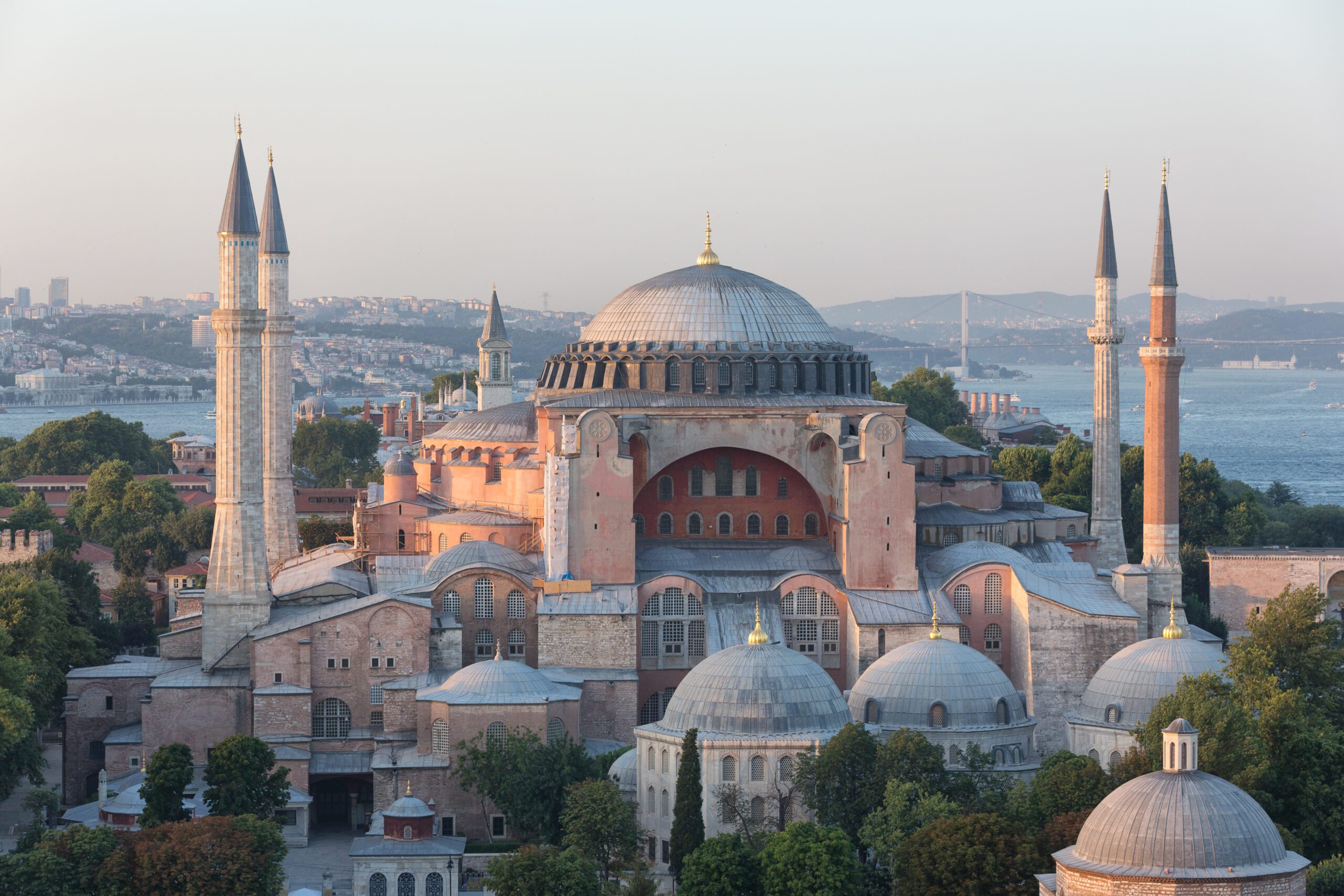
Once you get to Sultanahmet Square, you can’t miss the Hagia Sophia. It’s a massive light orange colored building that looks like a mosque.
There’s also pretty clear signage, and if you somehow get turned around, just ask a local.
Here is all the essential information you should know about visiting the Hagia Sophia, including the entrance fee, dress code, opening hours, and more.

Entrance Fee
The Hagia Sophia ticket price is €25 ($27). This might surprise you if you visited before 2024. For years, the building was completely free to tourists.
However, as of January 2024, the new tourist price is €25 (roughly $27). There’s still a special entrance in the back where local worshippers can enter the Mosque for free, but anyone visiting for travel or cultural reasons must pay to enter Hagia Sophia.
The Culture and Tourism Ministry has been working towards this for a few years, and it’s finally been instated.
They claim that this is to help mitigate the long queues at Hagia Sophia and allow for a less crowded experience. Tourists are required to enter and exit in designated spaces, taking the same route through Hagia Sophia.
In my opinion, this limits the ability to explore the Mosque at your own pace, so unfortunately, you can’t really find any unique unknown areas anymore.
You can purchase tickets in person, and if you’d like a more in-depth experience, consider booking a skip-the-line pass with a guided audio tour.

Hagia Sophia Opening Hours
Opening Hours: Open Daily 9:00am-7:30pm. Worshippers only Fridays 12:30-2:30pm
Cost: €25 ($27)
Phone #: +90 212-522-1750
Location: Sultan Ahmet, Ayasofya Meydanı No:1, Istanbul
Best time to Visit the Hagia Sophia
People have always said that the best time to visit the Hagia Sophia is during winter, in the early morning or late afternoon.
But that was mainly to avoid the insane crowds and long queues. With the new entrance fee and regulated entry, that’s likely to change.
So now, it doesn’t really matter which season you visit. Even in the summer, you’ll probably only have moderate crowds.
However, if you want the best chance of avoiding other tourists, try going in the late afternoon, a couple of hours before the Mosque closes.
➡️Visit Istanbul Highlights! Blue Mosque, Hagia Sophia, Topkapı and More!

Book your hotel near Hagia Sophia: Henna Hotel Istanbul
Henna Hotel Istanbul features air-conditioned rooms, a garden, free WiFi and a shared lounge. The accommodation provides airport transfers, while a bicycle rental service is also available.
Popular tourist sites near the Henna Hotel Istanbul includes the Hagia Sophia, Blue Mosque and Basilica Cistern.
➡️If you’re planning to stay nearby, here are some amazing accommodation options around Hagia Sophia

Dress Code at the Hagia Sophia
The dress code at Hagia Sophia centers around two things: Respect and Modesty.
You are required to remove your shoes before entering the Mosque, as well as wear clothing that covers your shoulders, arms, and knees.
They also ask that you cover any tattoos, wear loose-fitted clothing, and carry a scarf as a head covering. None of these will outright ban you from entry, but it’s respectful to adhere to the wishes of the local people.


Things to See at the Hagia Sophia
You don’t really need a tour to appreciate the splendor and beauty of Hagia Sophia. But there are some really interesting guided tours available that can give you even more cool insights.
Hagia Sophia is huge, and once inside, you’ll see why it’s so famous. Everywhere you look, you’ll find stunning mosaics, intricate artifacts, and unbelievable architecture!
When I visited, the most exciting part was seeing all the symbols from various times in history.


The Omphalion
The Omphalion is a large marble floor section with a complex pattern of circles of varying sizes. It’s right beneath the central dome of Hagia Sophia, and the artwork is stunning.
If you can believe it, the coronation ceremonies for Byzantine Emperors actually took place inside the Hagia Sophia. The emperor-to-be would sit on a gold chair on top of the Omphalion.
Over the years, the Omphalion has endured many alterations and some damage during the conversion from a cathedral to a mosque. However, you can still see some of the origins and original design.

Christian Mosaics
There are several Christian Mosaics that are still showing on the walls of the Hagia Sophia.
Tragically, when the Muslim Ottomans conquered Istanbul in 1453, they plastered over or destroyed the beautiful Christian mosaics. But in 1931, some westerners uncovered and miraculously restored some of the mosaics, including the following.


The Vestibule Mosaic
The first Christian mosaic you come across when you enter the Hagia Sophia is the Vestibule Mosaic. It is located over the south door of the vestibule (a vestibule is an entrance hall next to the outer door of a building).
In the mosaic, Justinian (who commissioned the Hagia Sophia) is handing a model of the Hagia Sophia to Mary and baby Jesus.
On the right-hand side of the mosaic, Emperor Constantine (famous for legalizing Christianity) presents the city of Constantinople to Mary and Jesus.

The Zoe Mosaic
Empress Zoe was the daughter of Byzantine Emperor Constantine VIII.
In the Zoe Mosaic, Emperor Constantine holds a purse, Jesus has an ornamental Bible, and Empress Zoe holds a scroll that lists her donations to the church.
Empress Zoe was married 3 times, so the mosaic of her husband had to be redone 3 times!

The Mosaic of John Komnenos and Eirene
In the Mosaic of John Komnenos and Eirene, Byzantine Emperor John is presenting a money purse to Mary and Jesus. The monograms MP OV you see over Mary’s head mean “Mother of God.”
Similar to Empress Zoe in the Zoe Mosaic, Empress Irene is holding a scroll that lists her donations to the church. To the right of this mosaic is a painting of their son Alexios (not shown in this photo).

The Mosaic of Leo VI
Byzantine Emperor Leo VI married several times in an attempt to have an heir. Since this was against church law, the church punished him.
In the Mosaic of Leo VI, Emperor Leo prostrates himself before Jesus to show repentance.
Mary’s hands are stretched toward Jesus, asking him to forgive Emperor Leo.


The Virgin and Child Mosaic
The oldest and most famous mosaic in Hagia Sophia is the Virgin and Child Mosaic.
It is located in the apse (a large semicircular recess in a church with a domed roof) at the east end of the ancient Cathedral.

The Dome
Like most Byzantine churches, the Hagia Sophia originally had a mosaic of Jesus’ face on the underside of the dome.
Sadly, when the Ottomans took over, they covered Jesus’ face with the 35th chapter of the Koran written in calligraphy.
Still, the dome is impressive, standing 186 feet tall and over 100 feet in diameter.


History of the Hagia Sophia
Hagia Sophia literally means ‘Holy/Divine Wisdom,’ an attribute attributed to its origin as a Cathedral dedicated to honoring God.
But the Cathedral has a tumultuous history, which I want to unpack for you.


Largest Christian Cathedral for 1,000 Years
The Hagia Sophia was a Christian Cathedral built by Byzantine/Eastern Roman Emperor Justinian from 532-537 A.D. It was located across from the Great Palace of the Roman Emperor, which is now the site of the Blue Mosque.
Hagia Sophia remained an Eastern Orthodox Cathedral until 1453 A.D. (except for a brief period from 1204 to 1261 A.D., when the Fourth Crusaders of the Latin Empire converted it to a Roman Catholic cathedral).
When it was built, the Hagia Sophia was the largest building in the world, and it held the title of the largest Cathedral in the world for the next 1,000 years.
The dome ceiling is so large that in 558 A.D., it collapsed after an earthquake and had to be replaced.

Converted into a Mosque in 1453
Muslim Sultan Ahmet I conquered Constantinople in 1453, thus expanding the Ottoman Empire.
After the conquest, the Ottomans converted all churches into mosques, including the Hagia Sophia. All Christian features were destroyed, such as the altar, bells, iconostasis, and other relics.
Pictures and mosaics were either destroyed or plastered over since they are considered idolatry in Islam. Thos included mosaics depicting Jesus, Mary, Christian saints, and angels (including those listed above).

Christian Features replaced by Islamic
When the Hagia Sophia was converted into a mosque in 1453, all of the Christian features were replaced with Islamic items. For example, Allah’s name was written in calligraphy on the right side of the altar. And Mohammed’s name – along with some caliphs – was written on the left side.
The Hagia Sophia was the primary Mosque in Istanbul until the Blue Mosque was built in 1616.
If you are interested in the subject, there is a Byzantium Istanbul Tour that takes you to all of the Byzantine churches that were converted into mosques.

Hagia Sophia Becomes a Museum
In 1931, secular Turkish President Kemal Atatürk agreed to Westerners’ requests to uncover and study some of the plastered-over Byzantine mosaics. A team led by an American named Thomas Whitemore set to work uncovering the mosaics throughout Hagia Sophia.
Since the building was still an active Mosque, a lot of people weren’t happy about this, but it actually led to the Mosque being established as a UNESCO World Heritage site.
This meant that it would be turned into a museum, which actually became a major pain point between the government and local conservative Muslims.


The Hagia Sophia remained a museum from 1934 to 2020. I visited it two years in a row when it was a museum, and I remember it being one of the most popular sights in the city!
The lines were so long, and I’ve seen statistics that 3.7 million people visited Hagia Sophia in 2019!
I wanted to learn everything I could about the ancient building, so I hired a local tour guide for $25.
It was worth every penny! I’m even still friends with him on social media!


Hagia Sophia Converted Back to a Mosque
On July 10, 2020, hearts around the world – including mine – broke when Turkish President Recep Tayyip Erdoğan signed a decree converting Hagia Sophia back into a mosque.
The Christian mosaics were covered in curtains, and the marble floors were covered in green carpet. The Omphalion—where Byzantine/Eastern Roman Emperors were crowned—is still visible but surrounded by carpet.

The Hagia Sophia now has even stricter visitation rules than the Blue Mosque. Tourists can enter the Blue Mosque to take pictures and walk around, but they must remain only in the permitted areas and follow a designated route through the exhibits.
This shift also concerned many historians, who feared the World Heritage site might be modified or damaged.
Luckily, they were able to keep protection over the site, and any modifications to the building must be approved by UNESCO!


Where To Stay in Istanbul
Istanbul offers a wide range of accommodations to suit various preferences and budgets. The city is divided into several distinct neighborhoods, each with its own unique character. To truly experience its magic, choose your base wisely. Sultanahmet offers historic charm; Beyoğlu/Karaköy pulses with nightlife; Bosporus-side districts offer upscale tranquility.
Here are three top-reviewed hotels for every budget:
Budget Accommodation – Fidelya Boutique Hotel (Sultanahmet)
Just steps from the Blue Mosque and Hagia Sophia, Fidelya Boutique Hotel blends affordability with historic charm. Guests love its cleanliness, welcoming hosts, and kitchenette-equipped rooms.
➡️Click here to book your stay at Fidelya Boutique Hotel!
Mid‑Range Accommodation – Pera Palace Hotel (Beyoğlu)
Pera Palace, Istanbul’s iconic museum‑hotel since 1895, sits in bohemian Beyoğlu near Istiklal Avenue. With elegant Art Nouveau décor and a nostalgic lounge, it’s ideal for travelers seeking history and style.
➡️Click here to book your stay at Pera Palace Hotel!
Luxury Accommodation – Four Seasons Hotel Istanbul at the Bosphorus (Beşiktaş)
For lavish comfort by the water, Four Seasons at the Bosphorus transforms a 19th-century Ottoman palace into a serene retreat. Featuring a spa with hammam, indoor/outdoor pools, and sweeping Bosporus views, it’s top-tier luxury.
➡️Click here to book your stay at Lucy HotelFour Seasons Hotel!
FAQs
Here are some commonly asked questions about the Hagia Sophia and my answers to each.

Is Hagia Sophia a mosque or church?
Hagia Sophia has served as both a church and a mosque throughout its history. It was originally built as a Christian cathedral in the Byzantine Empire in the 6th century AD. After the Ottoman Empire conquered Constantinople (now Istanbul) in 1453, it was converted into a mosque. In 1935, the Turkish government secularized the building and turned it into a museum. However, in 2020, it was reconverted into a mosque.

Can you visit Hagia Sophia at night?
Hagia Sophia is open from 9:00 a.m. to 7:30 p.m. every day. So, you cannot visit Hagia Sophia at night. However, certain events, guided tours, or festivals can offer you a chance to witness Hagia Sophia at night.

Which sultans are buried in the Hagia Sophia?
No sultans are buried within the Hagia Sophia itself. However, Sultan Mausoleums is situated right next to the Hagia Sophia. These 16th- and 17th-century sultans are: Mehmet III, Selim II, Murat III, İbrahim I and Mustafa I – most of whom are buried with members of their families.

Final Thoughts
Hagia Sophia is one of the most astounding buildings in Europe. It’s easy to get to from pretty much everywhere in Istanbul, and even though there is a pretty hefty entrance fee now, it’s still well worth it.
One of the best ways to get the most out of the experience is to book a combo tour that includes a tour guide for both Hagia Sophia and The Blue Mosque.
I find it so much more enjoyable when there’s a guide to help me understand the rich history around the building, but hopefully, this overview is a good start!
If you’re traveling to Istanbul, Hagia Sophia should definitely be on your itinerary. If you need even more ideas, check out this list of the best things to do in Istanbul!


