The Ultimate Top 8 Things to do in Salt Lake City + More 2026
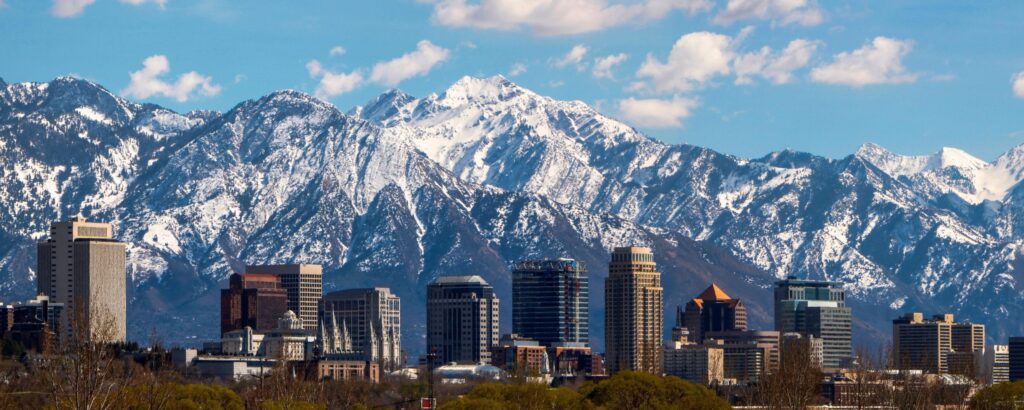
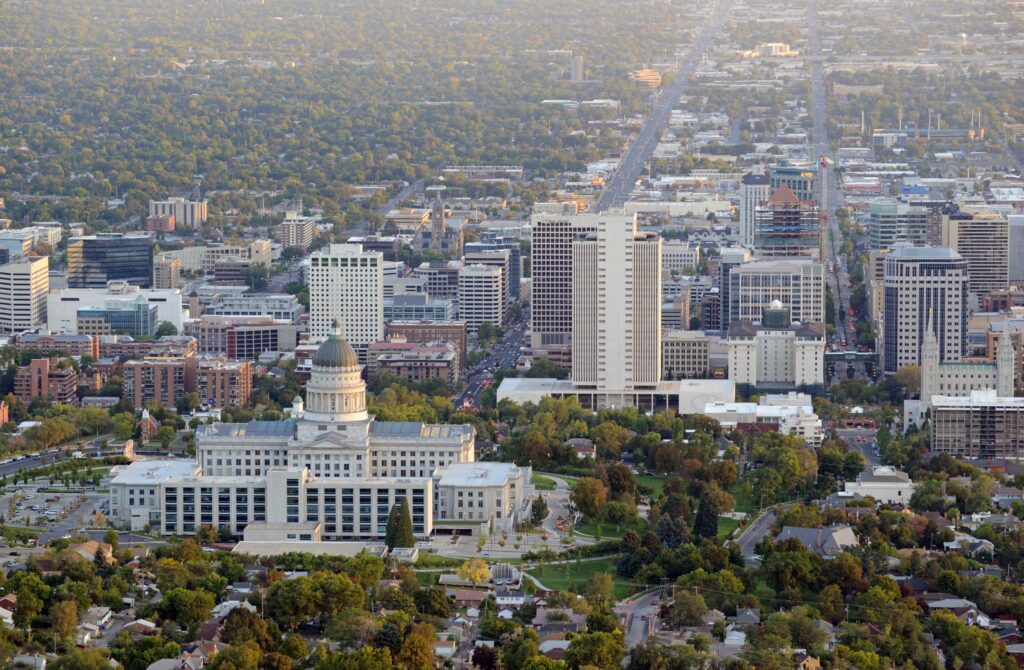
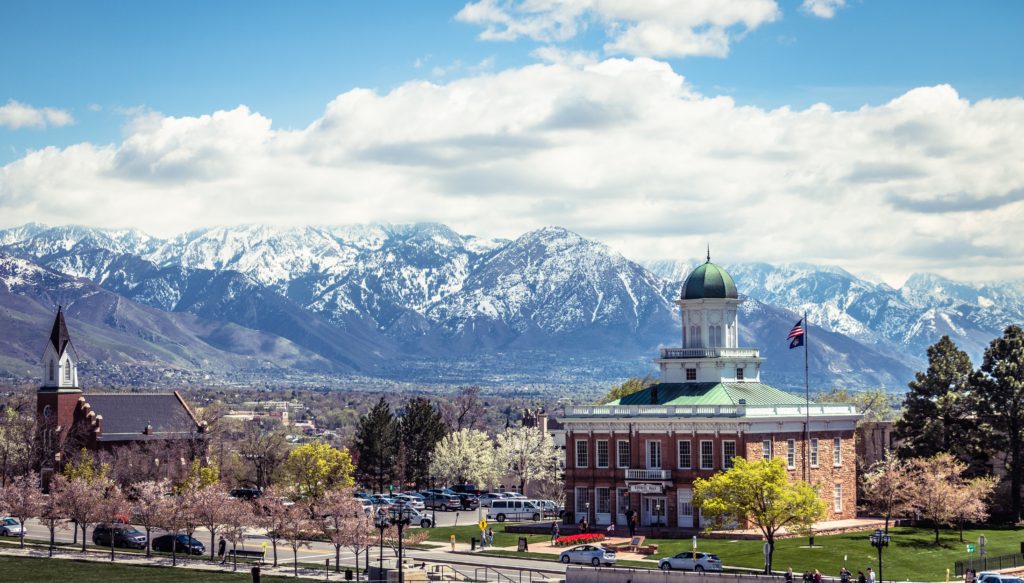
Salt Lake City is a beautiful, clean, spacious city located in a valley at the base of the Wasatch Mountains. It is the capital and most populous city in the state of Utah.
Things to do include the Salt Lake Temple, the Mormon Tabernacle Choir, the Mormon Family History Library, and the “This is the Place” Heritage Park. It is a great place to visit on the way to Utah’s National Parks – Arches, Bryce Canyon, Canyonlands, Capitol Reef, and Zion.
I have family in nearby Provo and have spent a lot of time in Salt Lake City. I am obsessed with researching my family history at the Family History Library!
Read on to learn the Top 8 Things to Do in Salt Lake City!

Plan Your Trip With My Favorite Resources
– Best accommodation site: Booking.com
– Book day tours here: Viator.com
– Purchase travel insurance here: SafetyWing
Founded by Mormons
Before you visit Salt Lake City, you need to know a little about its history.
On July 24, 1847, a convoy of Mormon pioneers in covered wagons descended from the Wasatch Mountains. They were fleeing religious and political persecution. Upon viewing the Salt Lake Valley for the first time, Mormon President Brigham Young famously stated, “This is the place.”
The pioneers settled in the valley and founded Salt Lake City. They considered it a fulfillment of the biblical prophecy of Isaiah 35:1 to “make the desert bloom as a rose.”
1. Visit Temple Square
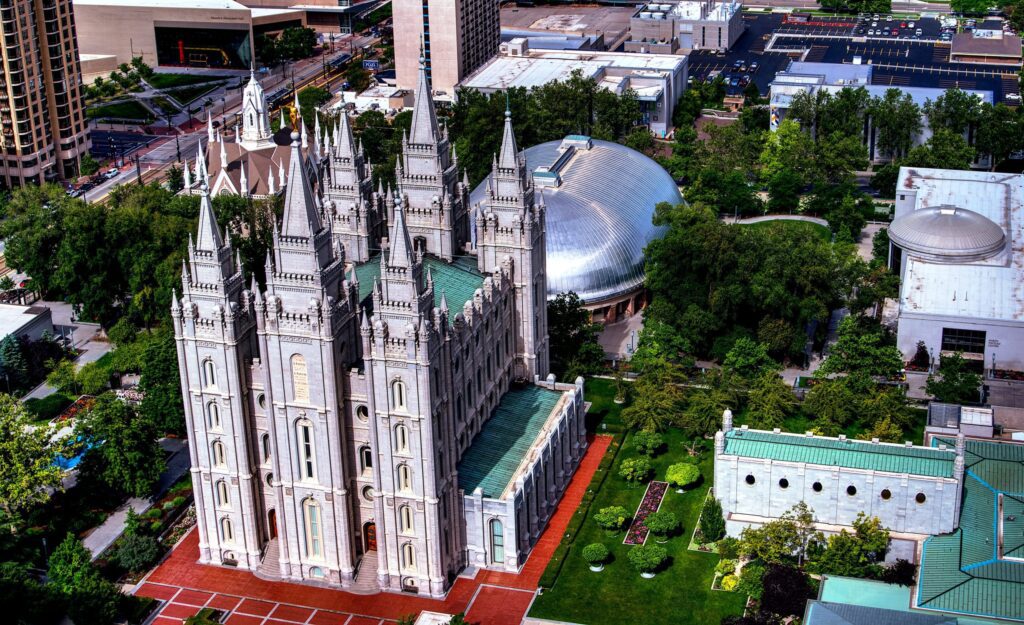
The # 1 thing to do in Utah is to visit Temple Square. The 35-acre square gets 3-5 million visitors ever year. Which is more than all 5 of the state’s national parks (Arches, Bryce Canyon, Capitol Reef, Canyonlands, and Zion) combined.
Temple Square is open daily from 9:00am-9:00pm and free tours are offered in 40 languages. There are also several Dining Options located on the square.
Check out my blog Top Things To Do in Canyonlands National Park!
2. View the Mormon Salt Lake Temple
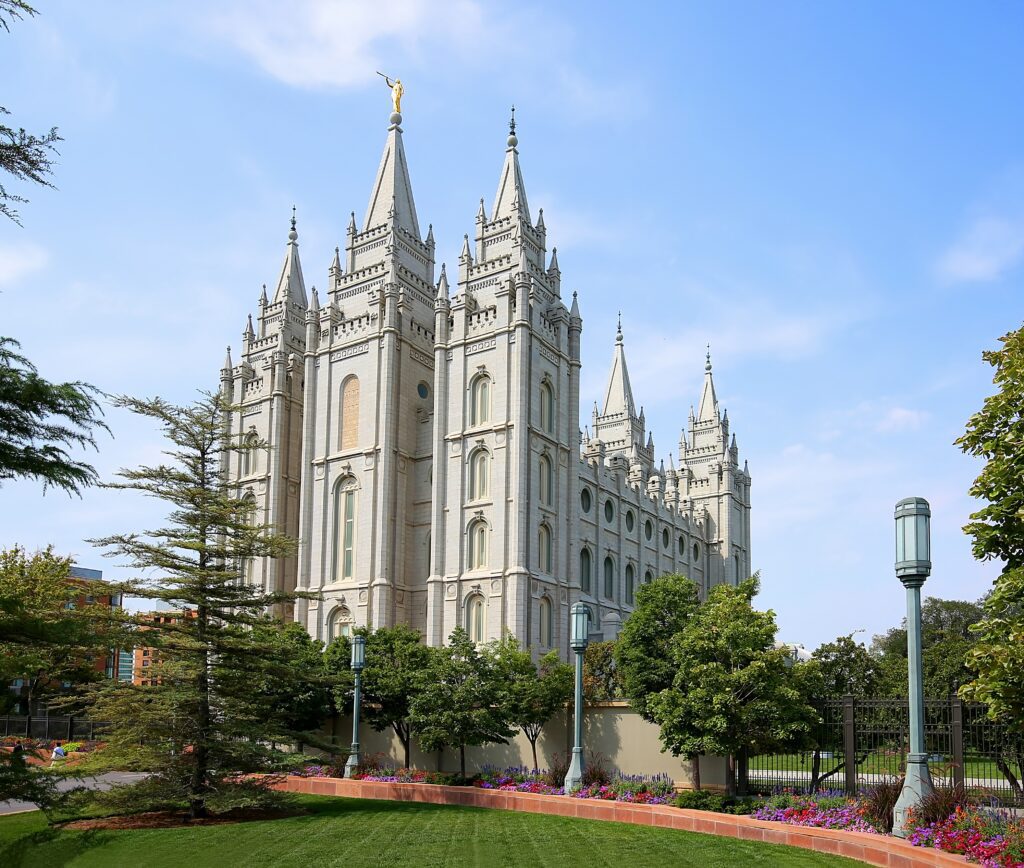
The crown jewel of Temple Square is the world renown Salt Lake Temple. The majestic neo-Gothic granite building is the largest Mormon temple in the world.
Mormon President Brigham Young chose the location of the temple 4 days after the pioneers arrived in 1847. It took 40 years to build.
Salt Lake City was built on a grid system around the temple. The southeast corner of Temple Square is literally the physical center of the city. (Scroll to bottom for more info).
Only Open to Church Members
Ceremonies such as marriages and baptisms are performed at the temple. It is considered sacred, so only church members in good standing are allowed to enter; not the general public.
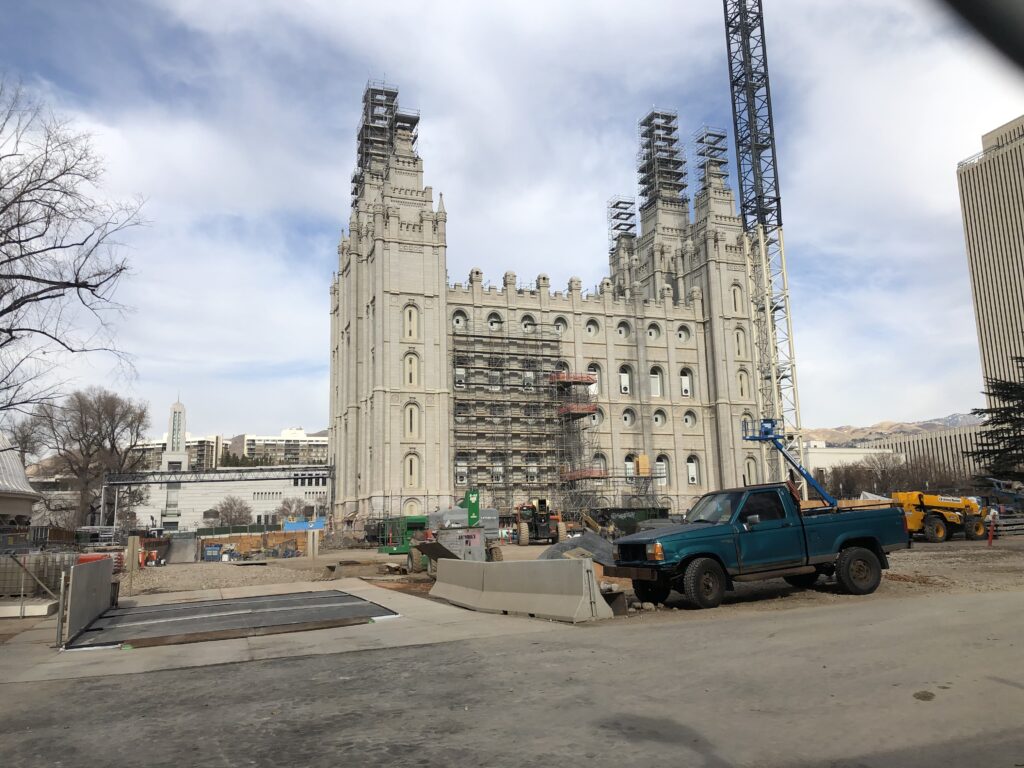
In December 2019 the temple was closed for renovations. Three months later a 5.7 magnitude earthquake hit Salt Lake City, and the Angel Moroni statue (which sits on top of the highest spire) famously lost its trumpet.
Check out my blog Explore Moqui Cave – Dinosaur Tracks & Native Artifacts!
3. Listen to the Mormon Tabernacle Choir
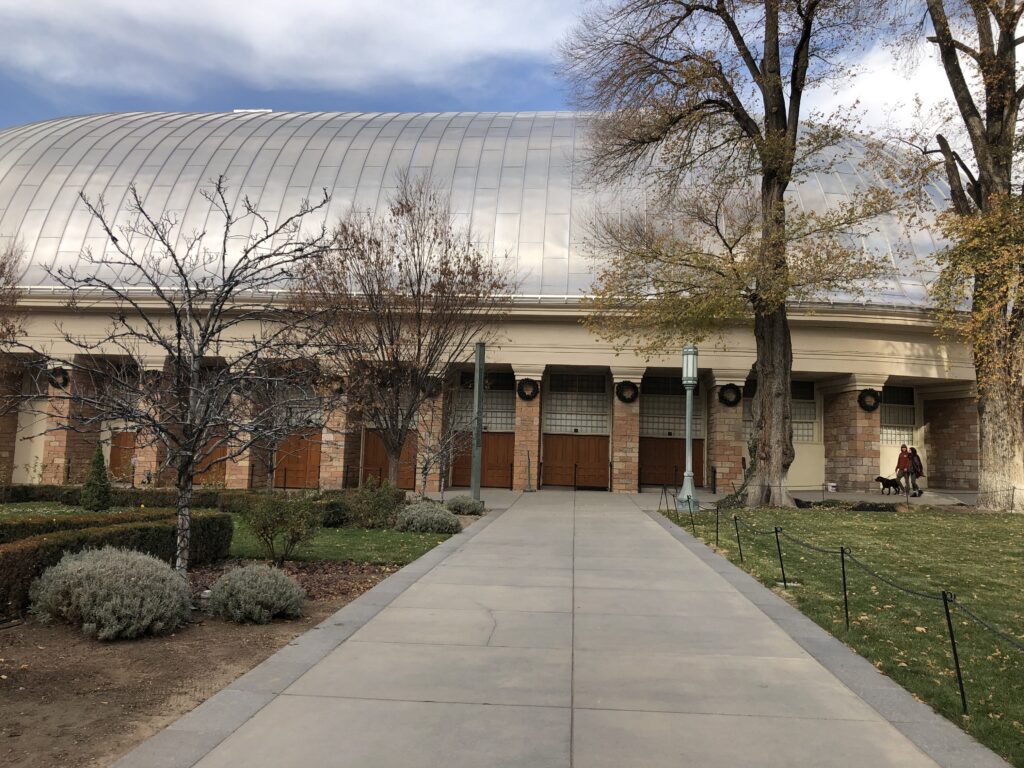
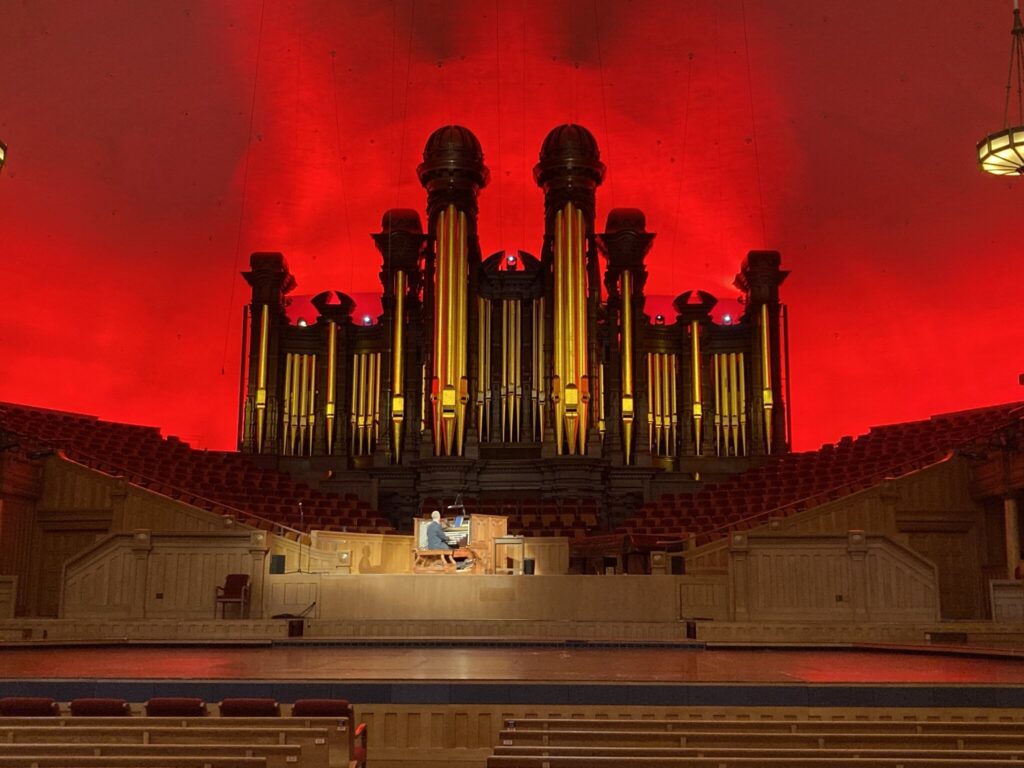
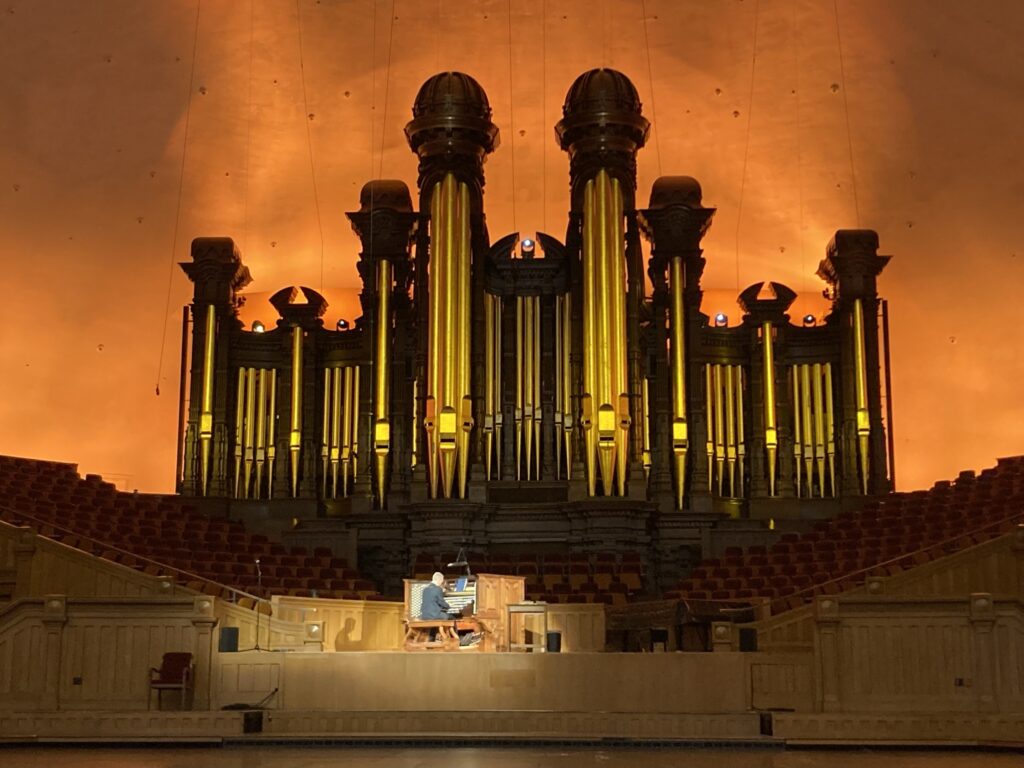
Next door to the Salt Lake Temple is a dome shaped auditorium called the Salt Lake Tabernacle. The Grammy winning Mormon Tabernacle Choir has been performing there since 1864.
The 360-choir members and 110-orchestra members are volunteer church members who do not get paid. Check out these stunning pictures of the choir and tabernacle!
Choir Schedule
The Mormon Tabernacle Choir performs Music and the Spoken Word every Sunday morning at 9:30am. Most Sundays it is held on Temple Square. However, during peak season (summer and Christmas) the performance is moved across the street to the LDS Conference Center. Doors open at 8:30am and no ticket is required.
(Note: Tickets are required for the annual Christmas concert.).
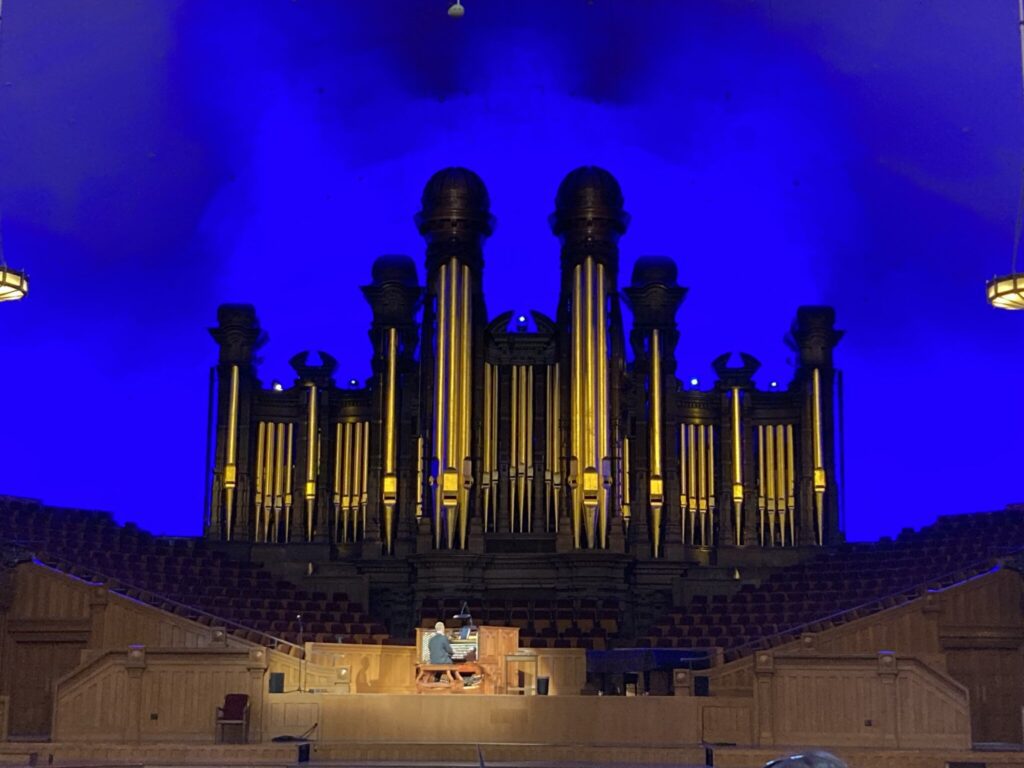
The choir’s Daily Organ Recitals are also open to the public. The 30 minute performances are a century long tradition.
World Famous Pipe Organ
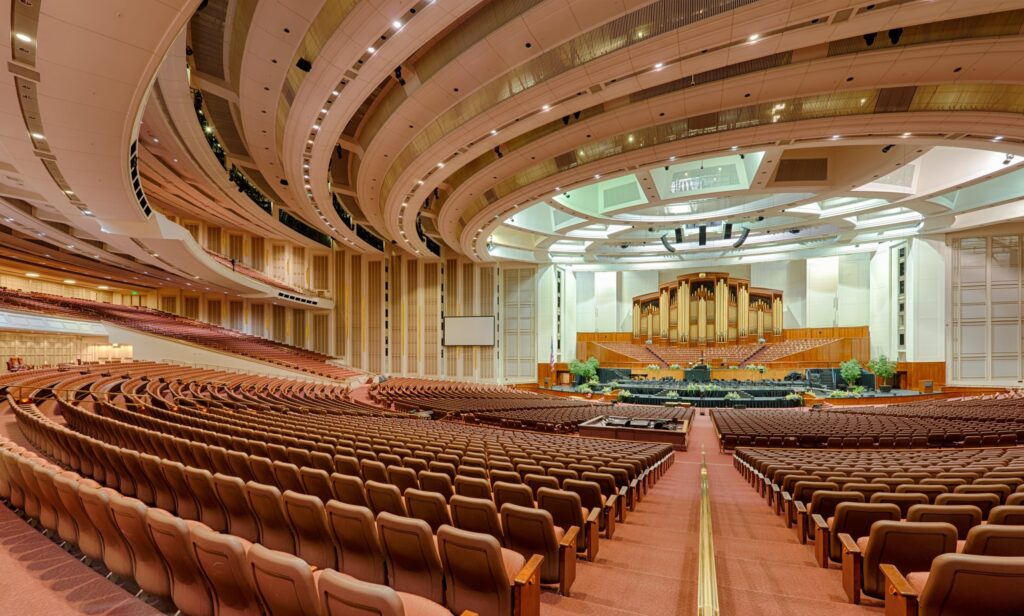
The Tabernacle building is considered an acoustic wonder. Amazingly, a pin dropped at the pulpit can be clearly heard at the back of the hall 170 feet away!!!
The magnificent pipe organ has 11,623 pipes and usually accompanies the choir.
Handel’s Messiah
The Mormon Tabernacle Choir is best known for its breathtaking performance of Handel’s Messiah, which it has performed since 1870. (It’s on my Christmas playlist). PLEASE LISTEN TO THE VIDEO BELOW! IT IS ABSOLUTELY BEAUTIFUL!
4. Research your Family History at the Family History Library
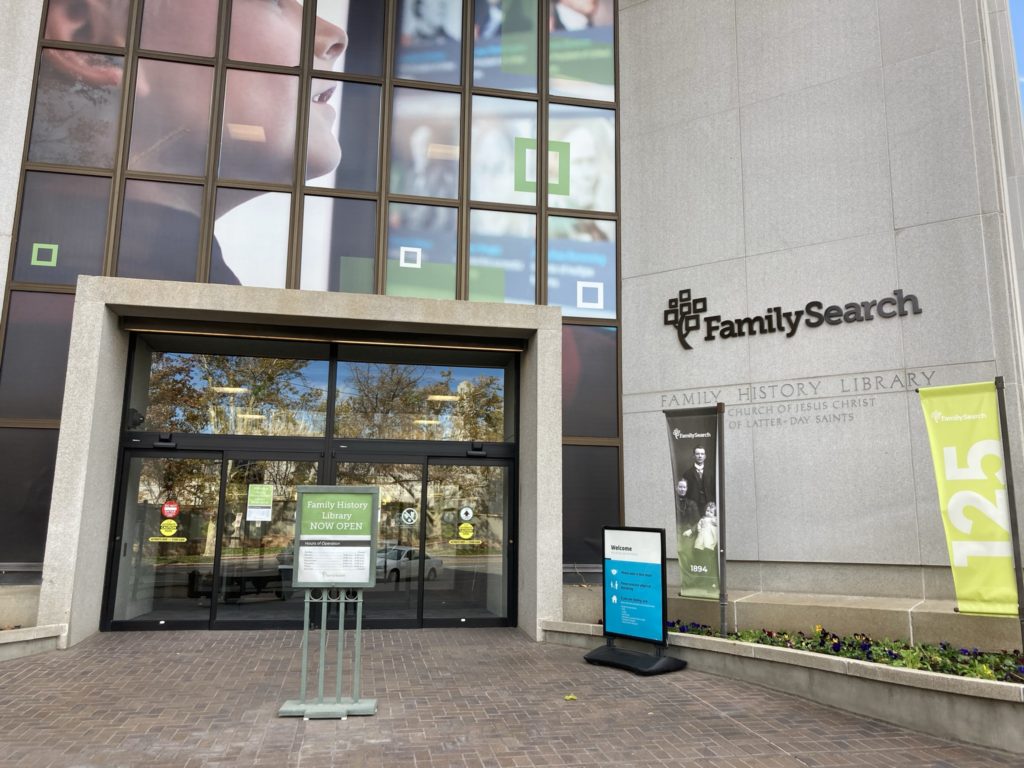
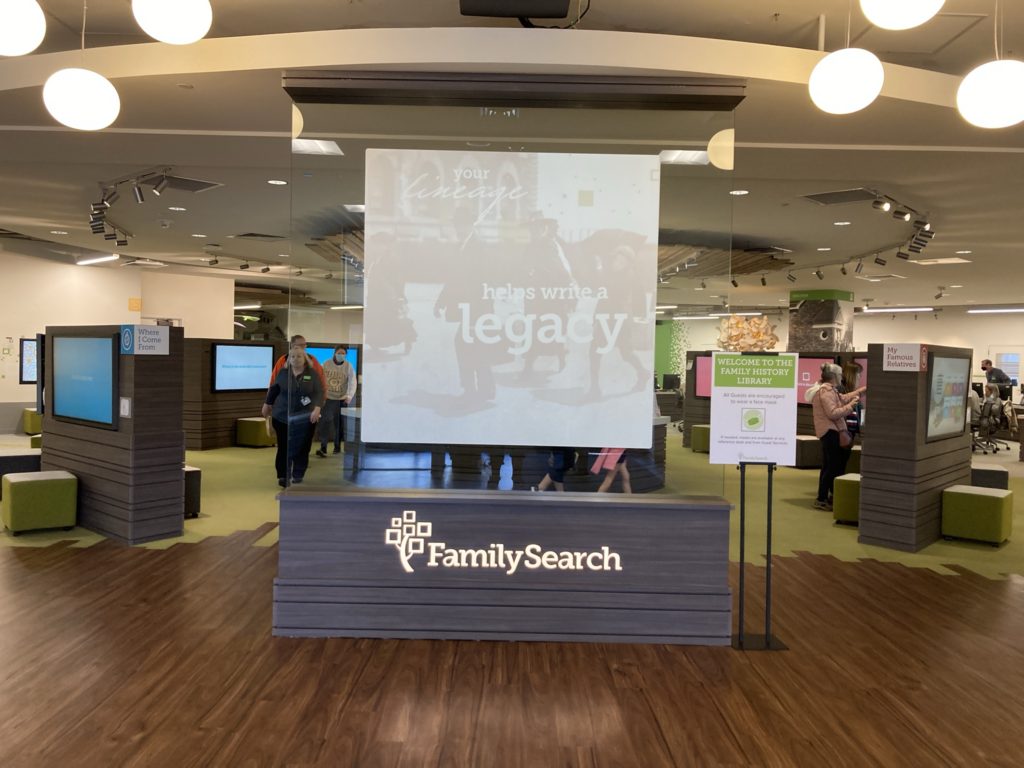
Across the street from Temple Square (next door to the Mormon History Library) is the Mormon operated Family History Library. It houses the largest collection of genealogical records in the world!
The library houses millions of documents that contain the names of over 3 billion deceased people. Visitors can use the library for free with the help of professional staff and volunteers. Both times I was there a librarian sat with me for several hours.
Mormon interest in genealogy is well known. The reason is because they believe that baptizing their deceased relatives (using a proxy of the same sex) allows the relative to enter heaven. The rest of us get to benefit from this belief!
My Experience at the Family History Library
The Family History Library uses the Family Search website to create family trees. I am pretty tech savvy, but on my first trip to the library I needed a volunteer to sit with me for the entire 3 hours.
As we began researching my paternal grandfather’s family, we discovered that a distant relative I never heard of had created a “branch” of that part of my family tree dating back to 1791!!! I was so excited I cancelled my plans the next day and spent another day at the library.
My father’s side of the family is from Greece. When the Nazis occupied Greece during World War II they destroyed all of the records. Fortunately for me, the library has a specialist on Greek records.
5. Tour other Buildings on Temple Square
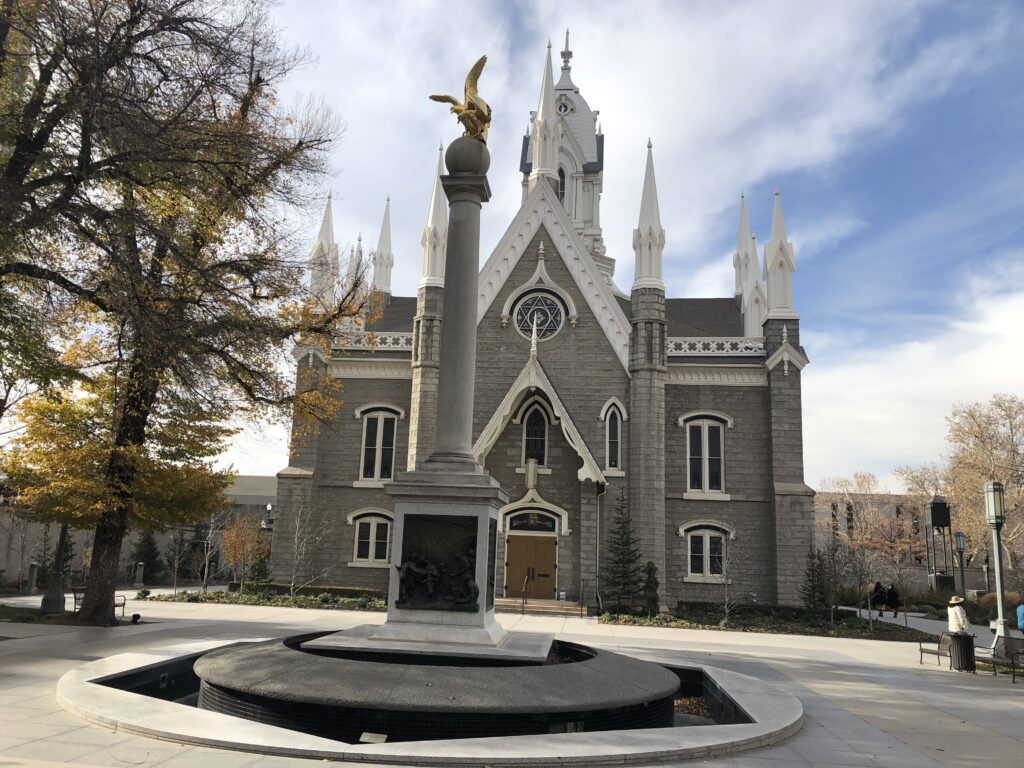
Assembly Hall (built in 1882) is a Gothic Revival style building that was the original place of worship for local Mormons. It’s now used for lectures, recitals, and free weekend concerts.
The 21,000 seat LDS Conference Center (built in 2000) hosts the LDS church general conference every April and October. It is the largest theater style auditorium in the world and feautures terrace views of the Salt Lake Temple.
Beehive House (built in 1854) was the primary residence of Mormon President Brigham Young from 1855 to his death in 1877. It’s named after a beehive on top of the house, which Young considered a symbol of industry. The beehive later became Utah’s state emblem.
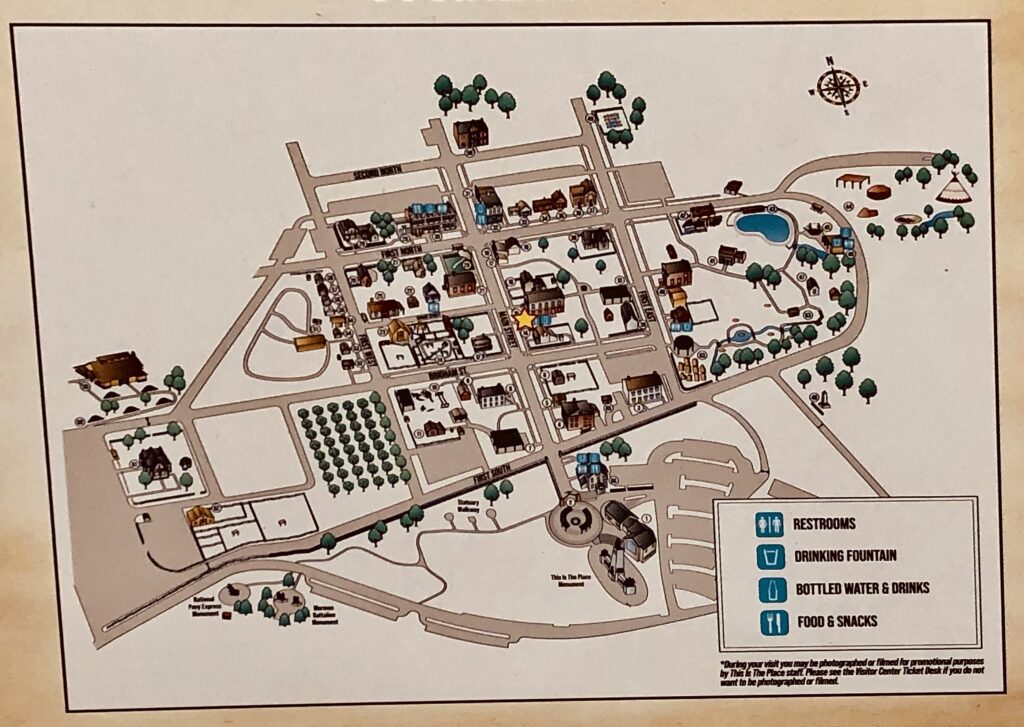
6. Visit “This is the Place” Heritage Park
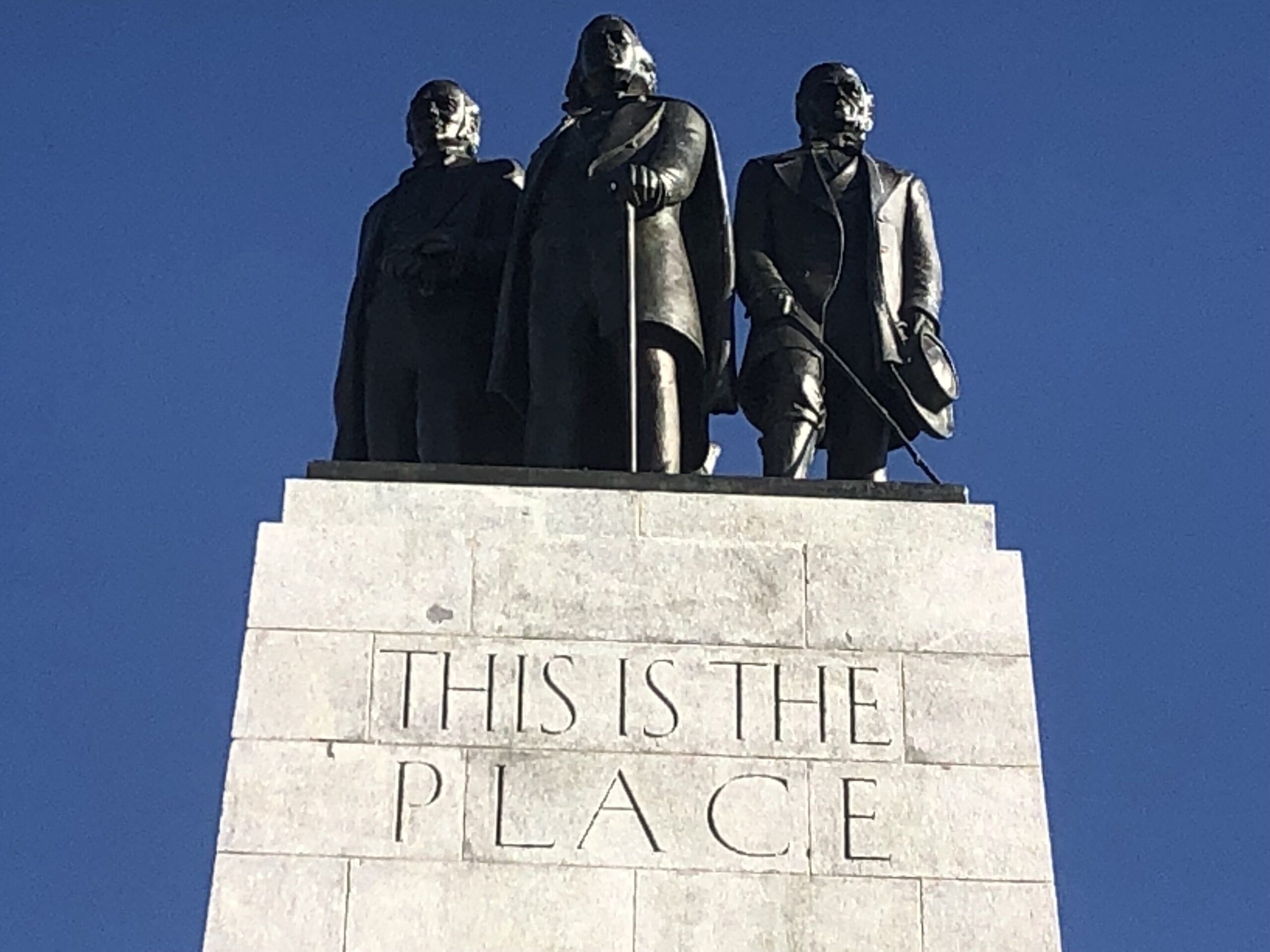
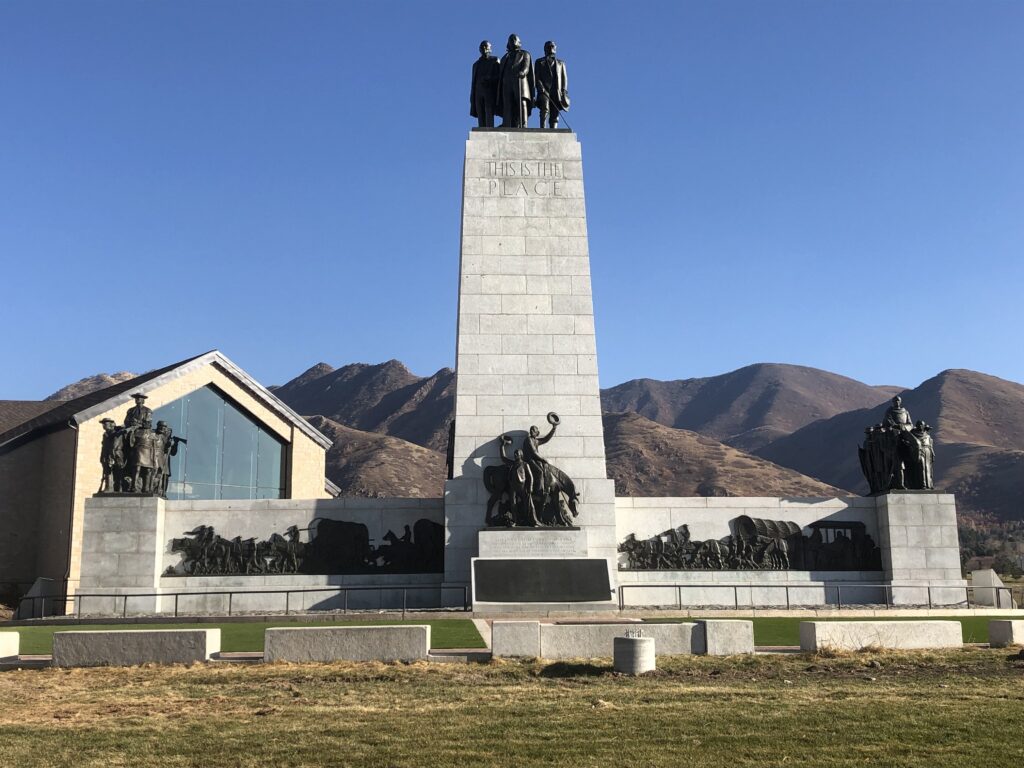
Upon viewing the Salt Lake Valley for the first time, Mormon President Brigham Young famously stated, “This is the place.” He later claimed that he had seen the valley in a vision and recognized it.
The Mormons settled in the valley and founded Salt Lake City. A magnificent monument now marks the exact spot at This is the Place Heritage Park.
Living Representation of an Early Settlement
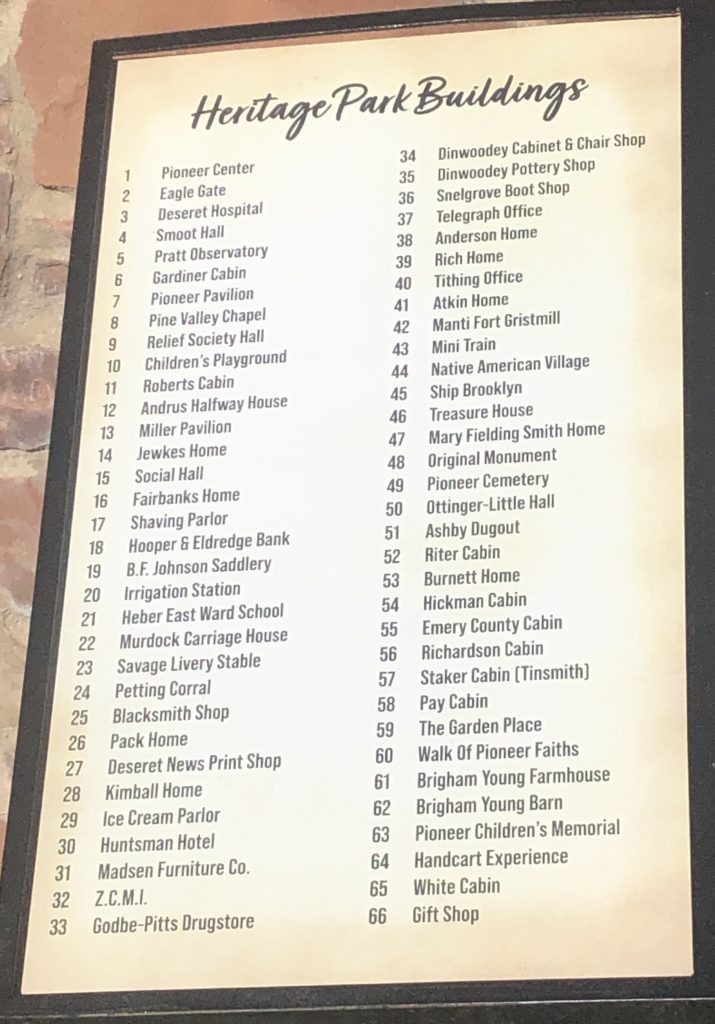
The park is a living representation of an early settlement in the Utah Territory. It contains over 60 structures, including a farmhouse and barn owned by Brigham Young, a church, hospital, and pioneer cemetery.
The structures were originally built at locations all over Utah. They were either relocated or reconstructed and placed in the park. Read more about the structures here.
Petting Zoo, Pony Rides & More
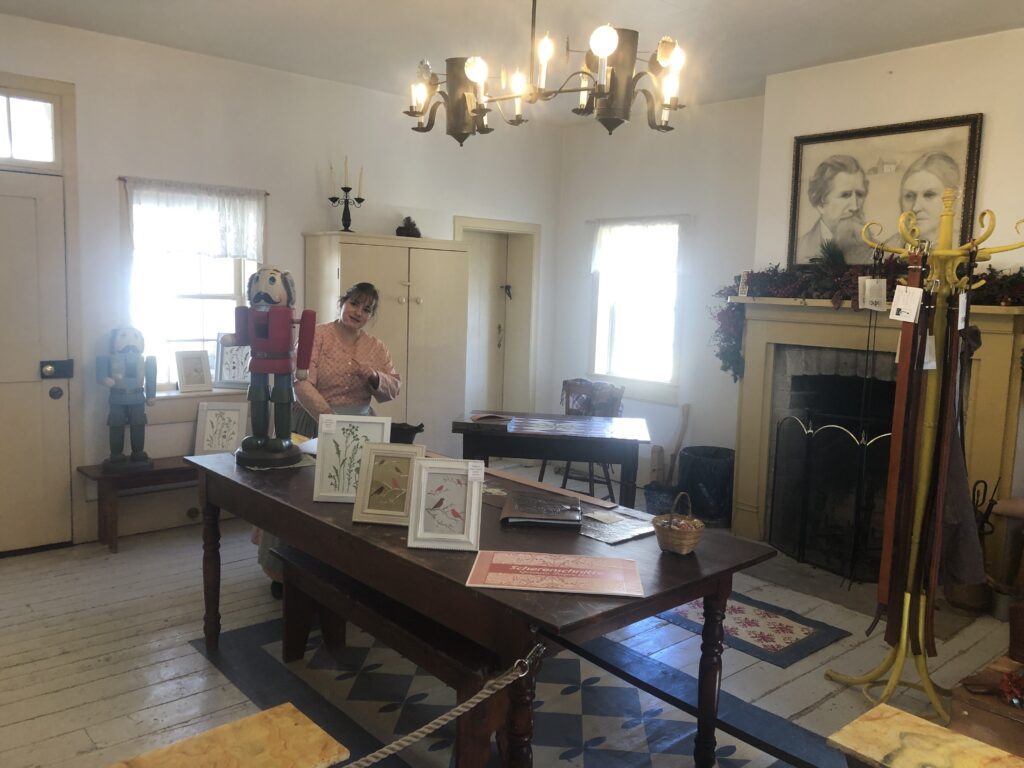
Actors and actresses in costume give live re-creations of various tasks. On any given day you might see a blacksmith, tinsmith, saddle maker, various old-fashioned pioneer chores, spinning and carding wool, a bucket brigade, a variety of musical performers, and the occasional train robbery.
For the kids there is a petting zoo, pony rides, a miniature train ride around the lake, and a playground. And in the hot summer months there is an Irrigation Station splash pad.
Educational Videos
The park’s website has some really great videos of behind-the-scene tours and demonstrations by actors in period costume at the telegraph office, black smith, Native American Village, etc.
I highly recommend the video titled “A brief history of the settlement of the West” (halfway down on the left). It tells the story of the Mormon settling of Salt Lake City.
Brigham Young’s Forest Farm
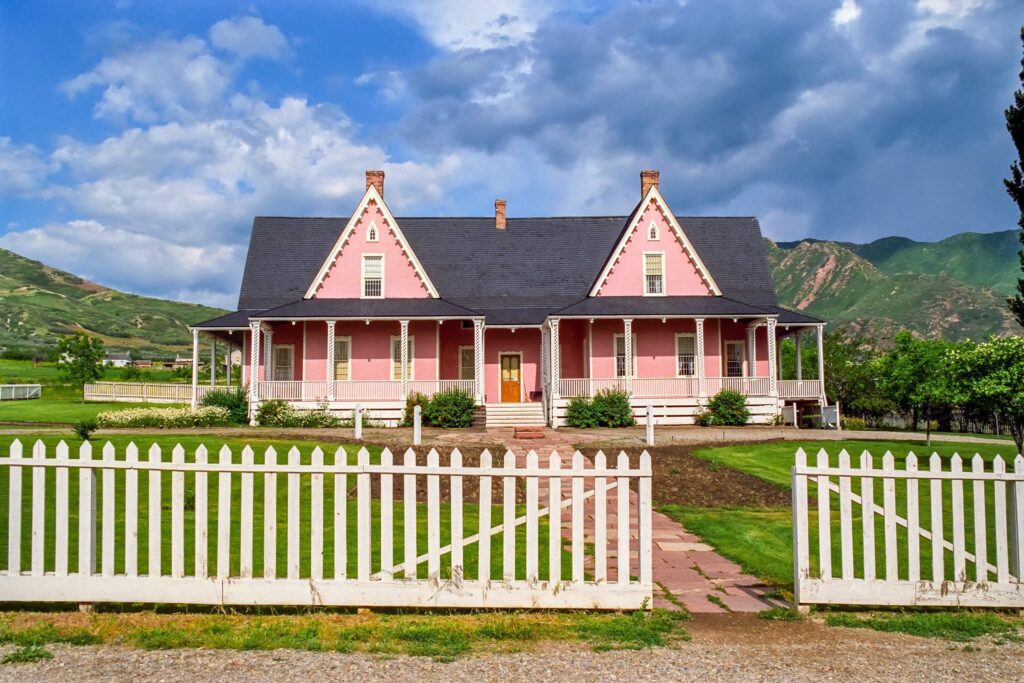
The highlight of This is the Place Heritage Park is a farmhouse and barn owned by Mormon President and Utah Territory Governor Brigham Young.
The farmhouse was built in 1863 on Young’s 600-acre farm. He named it Forest Farm after all of the trees on the property.
Young owned several houses. He never lived in Forest Farm. Insted, he used it as a “show place” for visiting dignitaries and guests. He and his family held musical performances, square dances, and dinner parties in the home’s second-story ballroom.
Pine Valley Chapel
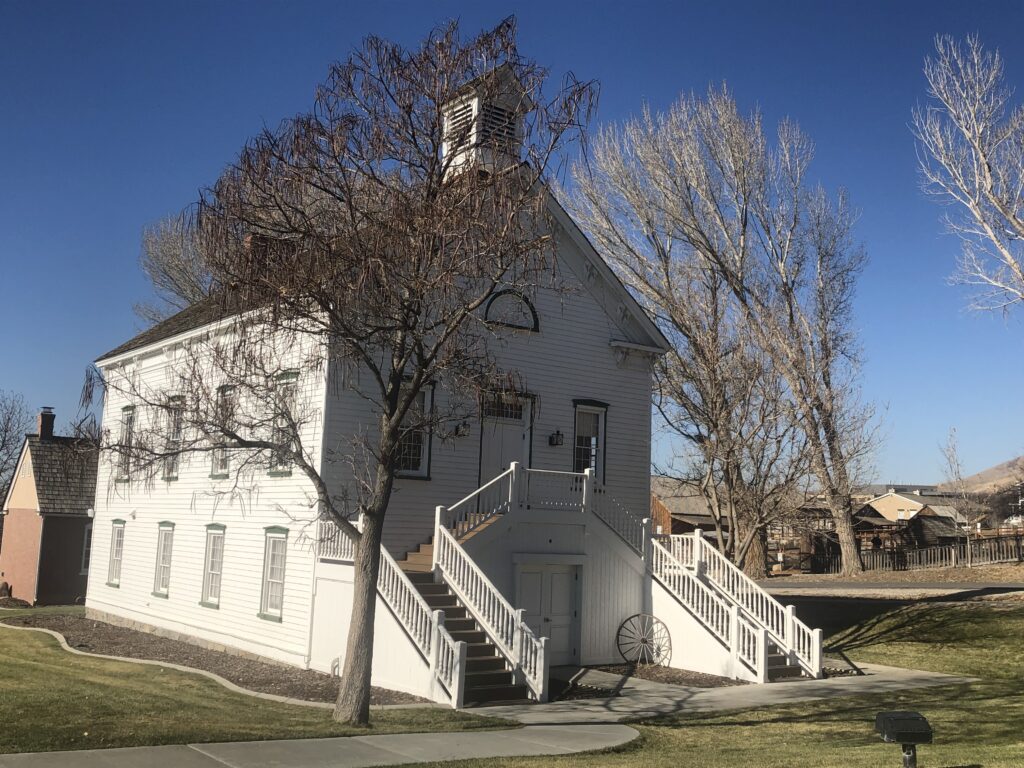
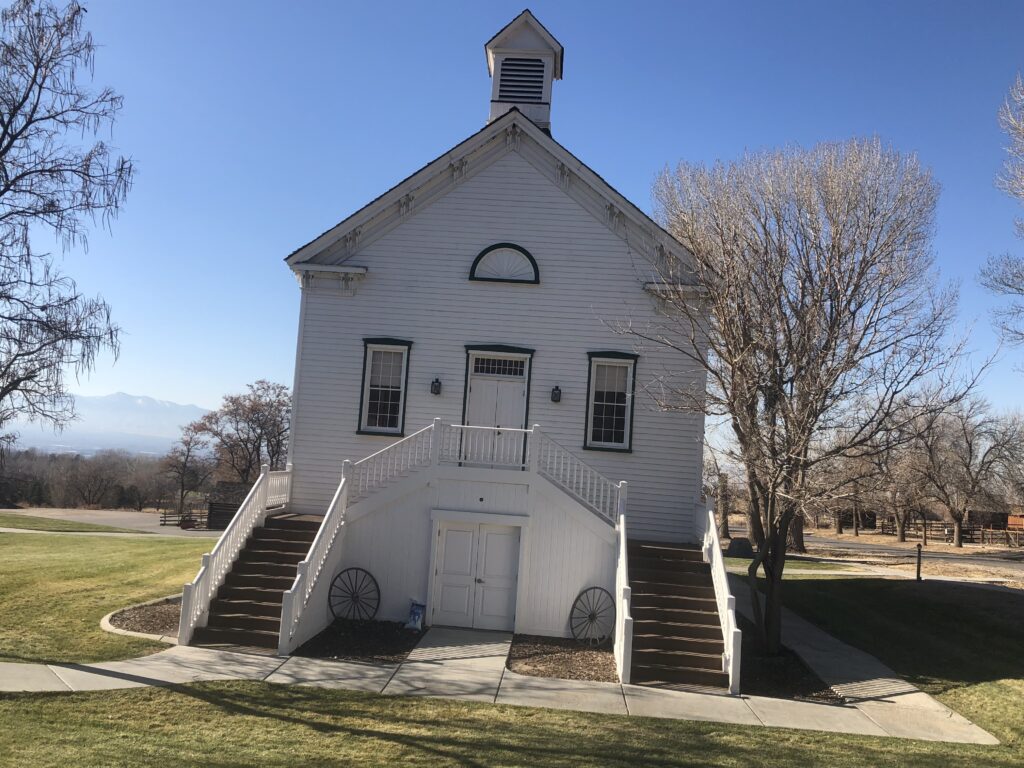
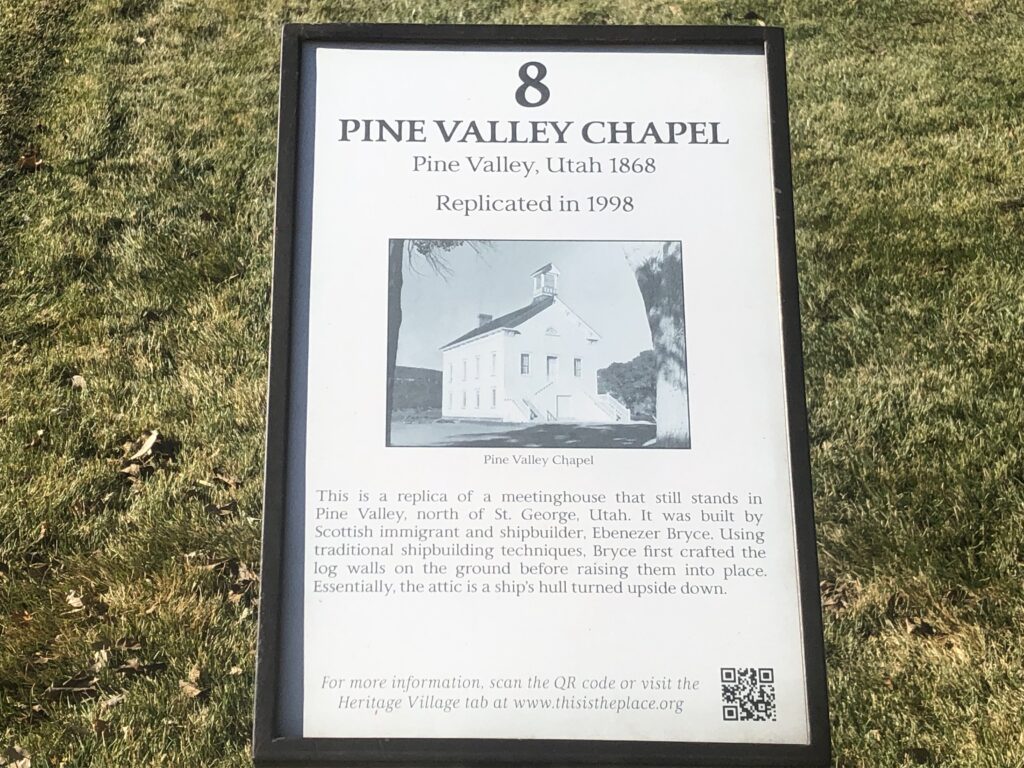
Pine Valley Chapel is a replica of a beautiful church built in Pine Valley, Utah in 1868. The original church still stands in the town of Pine Valley, 45 minutes north of St. George.
The church was built by Ebenezer Bryce, a Mormon pioneer best known as the person for whom Bryce Canyon National Park was named. Bryce was a Scottish immigrant and ship builder.
Herbert East Ward School
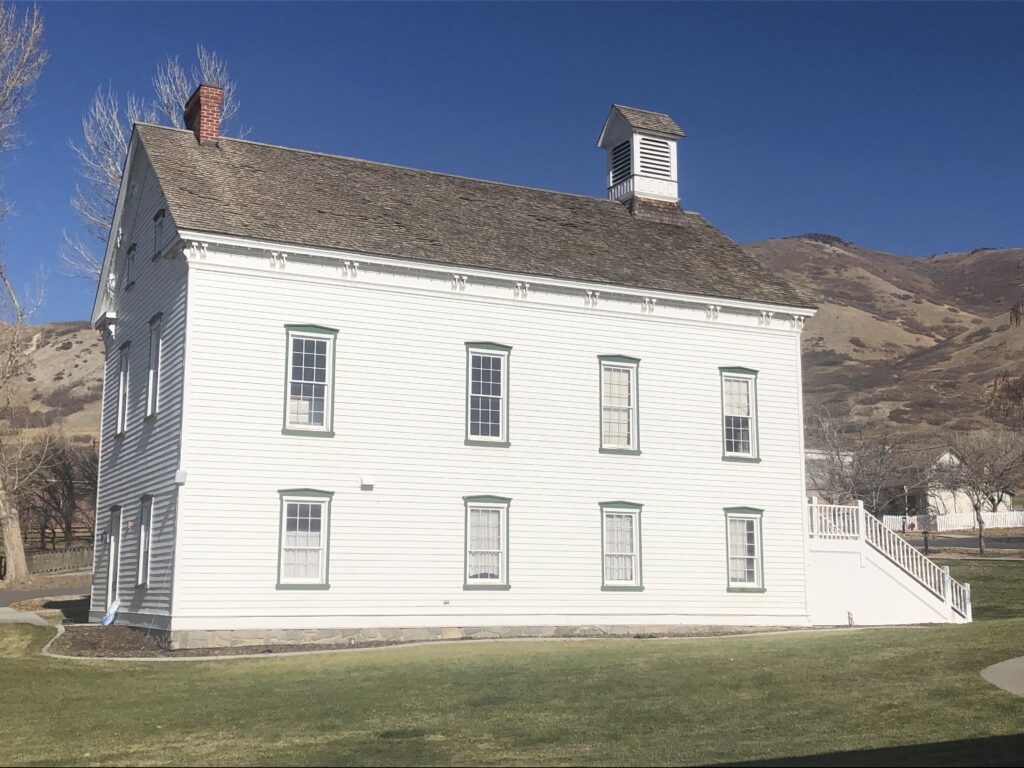
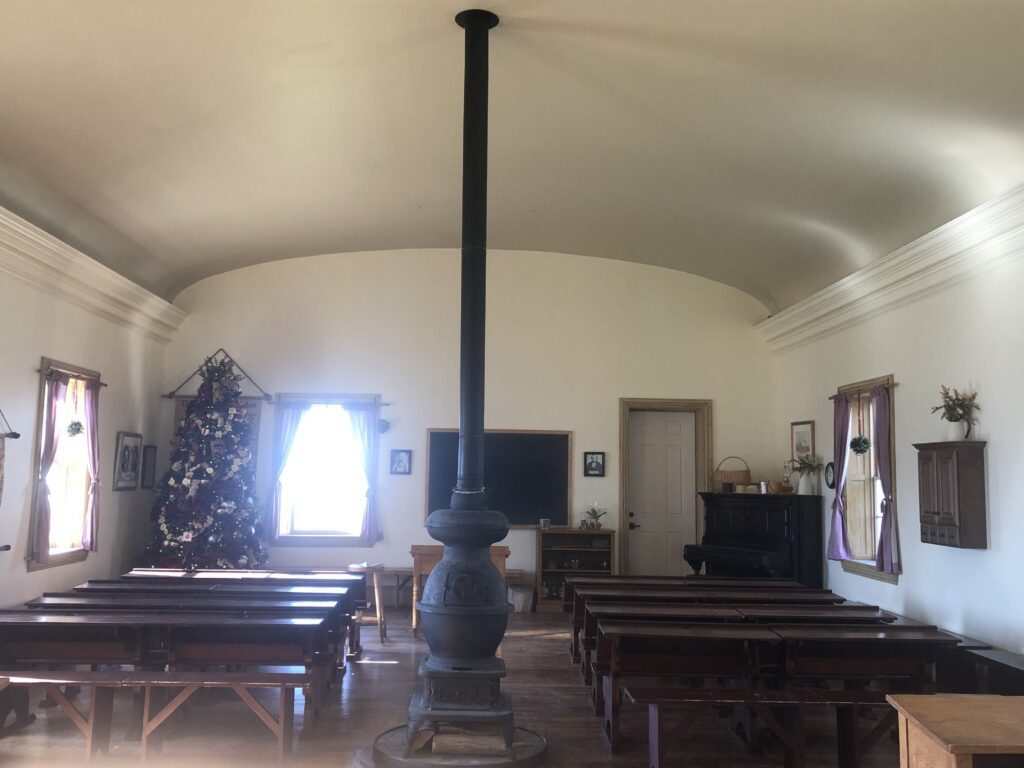
The Heber East Ward school was built in Heber City, Utah in 1865.
On weekdays the building was used a school house. On the weekends it was used as a social hall for parties, dances, and quilting bees. And on Sundays it was used as a church.
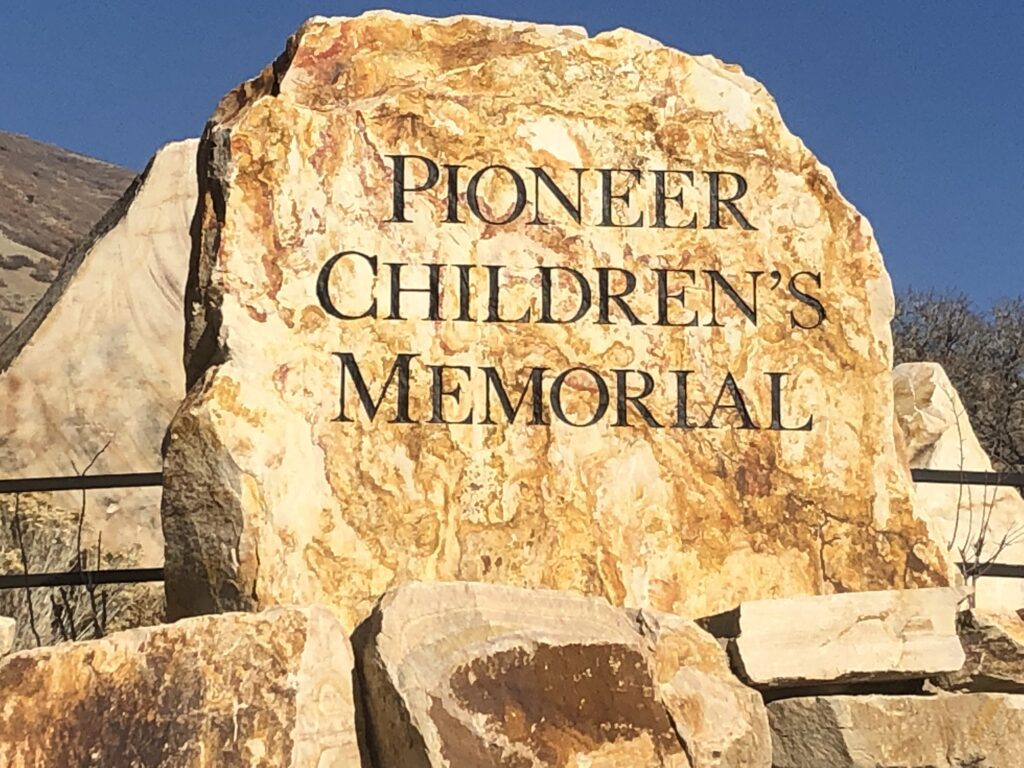
Pioneer’s Children’s Memorial
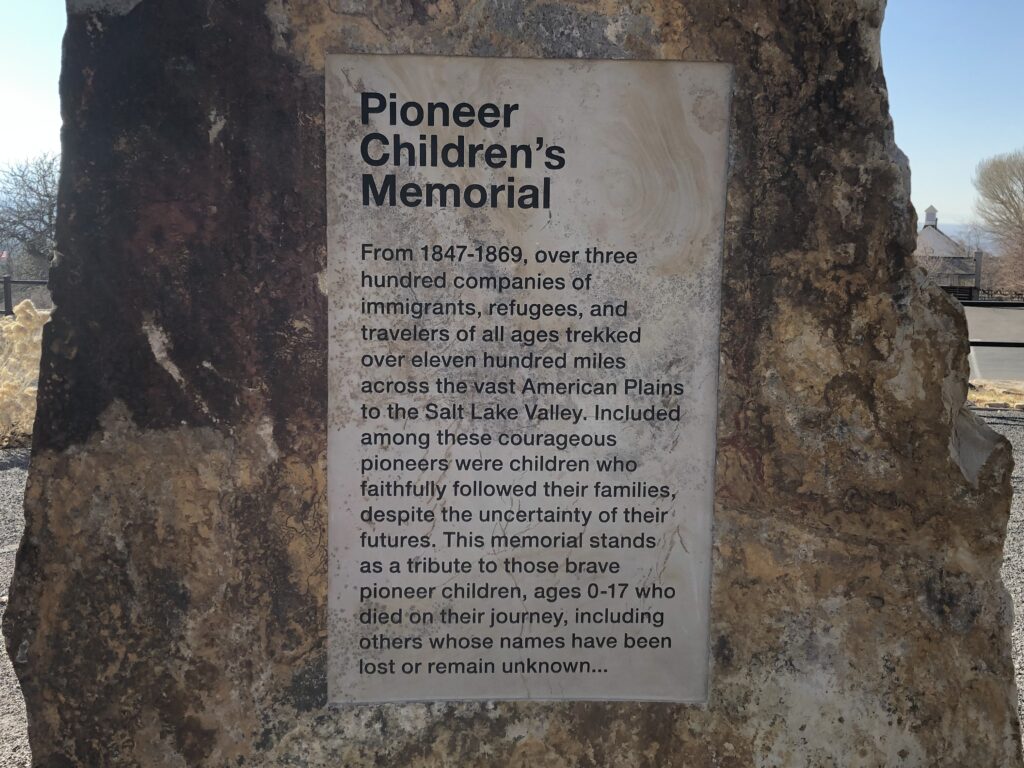
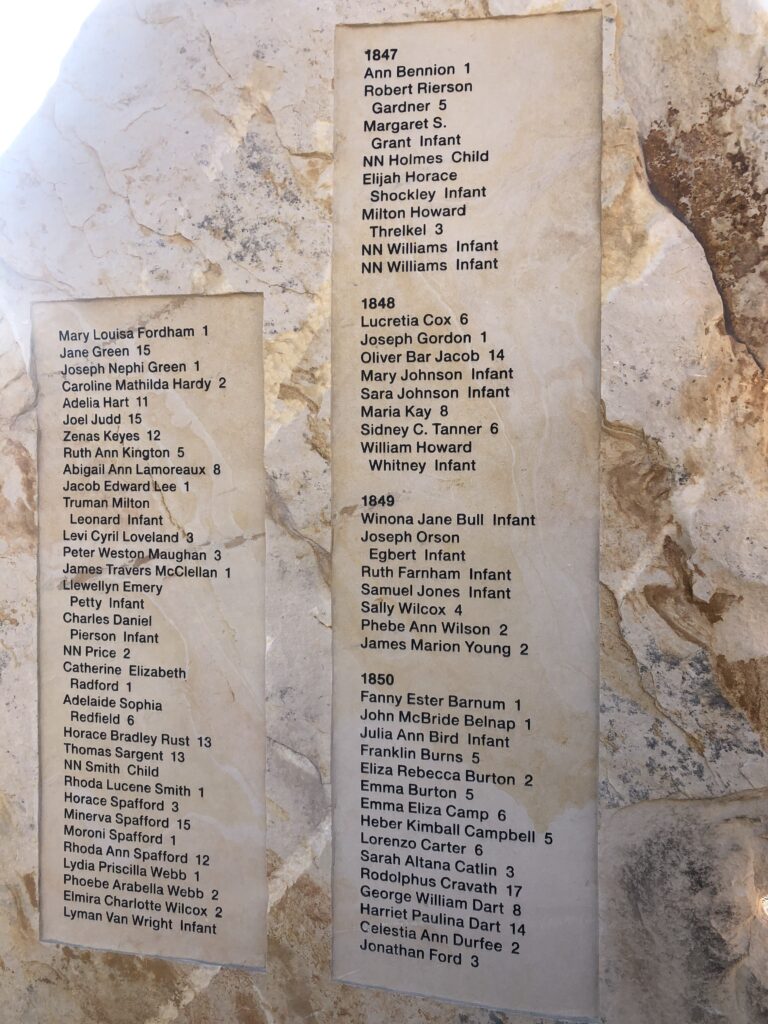
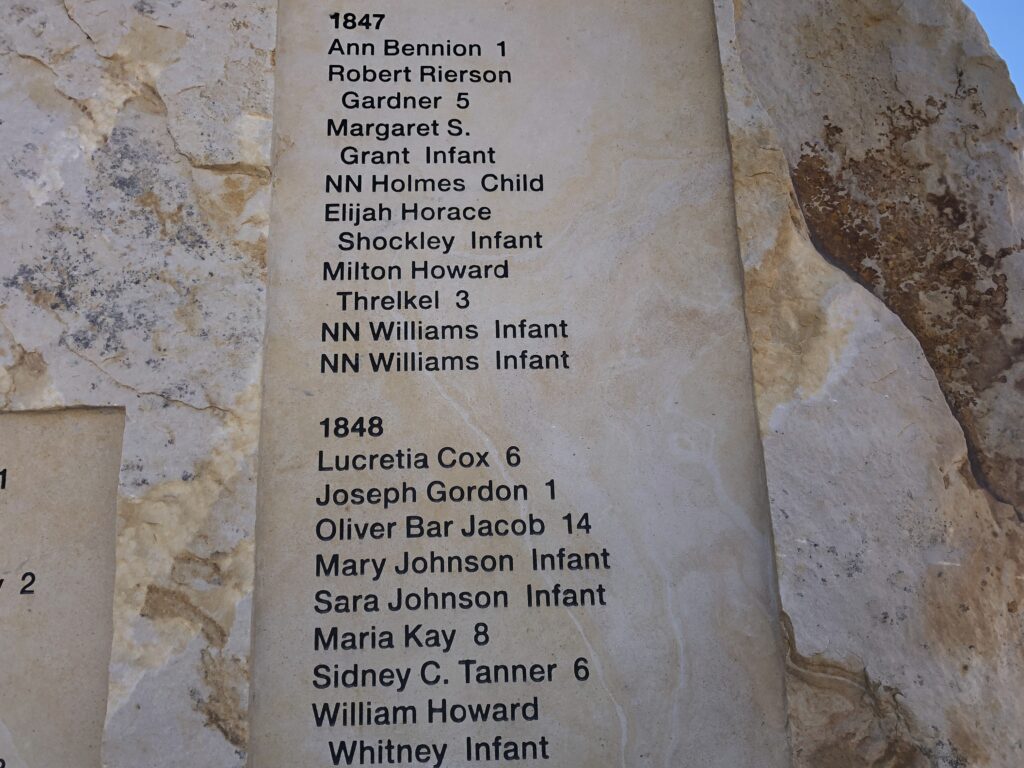
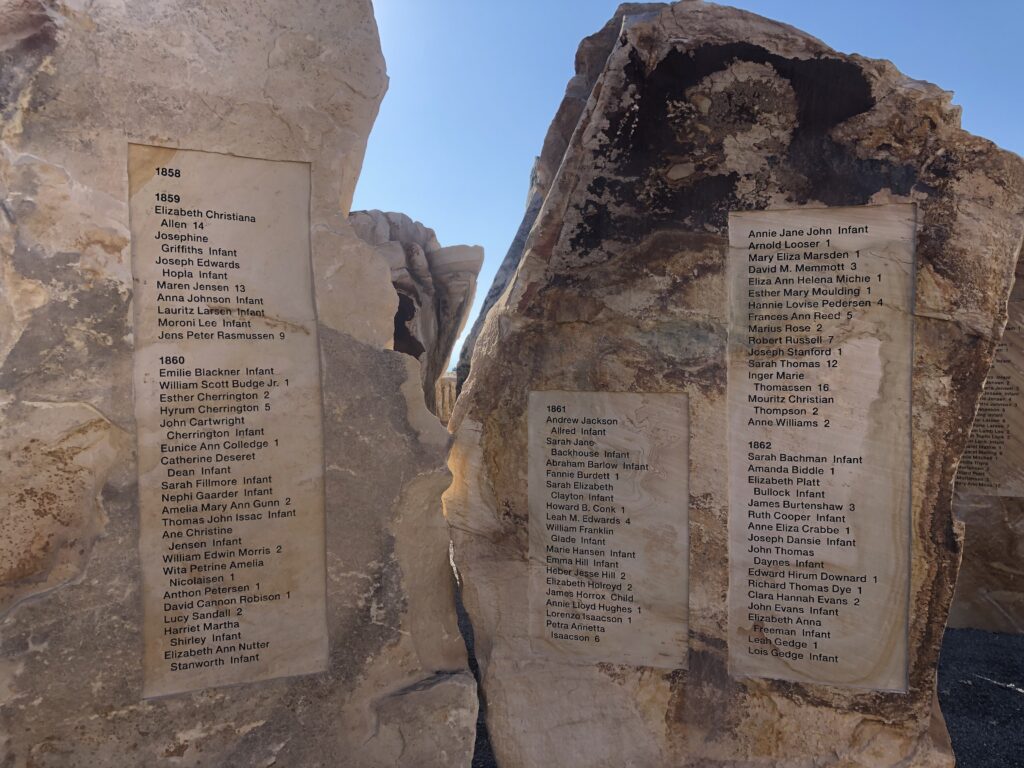
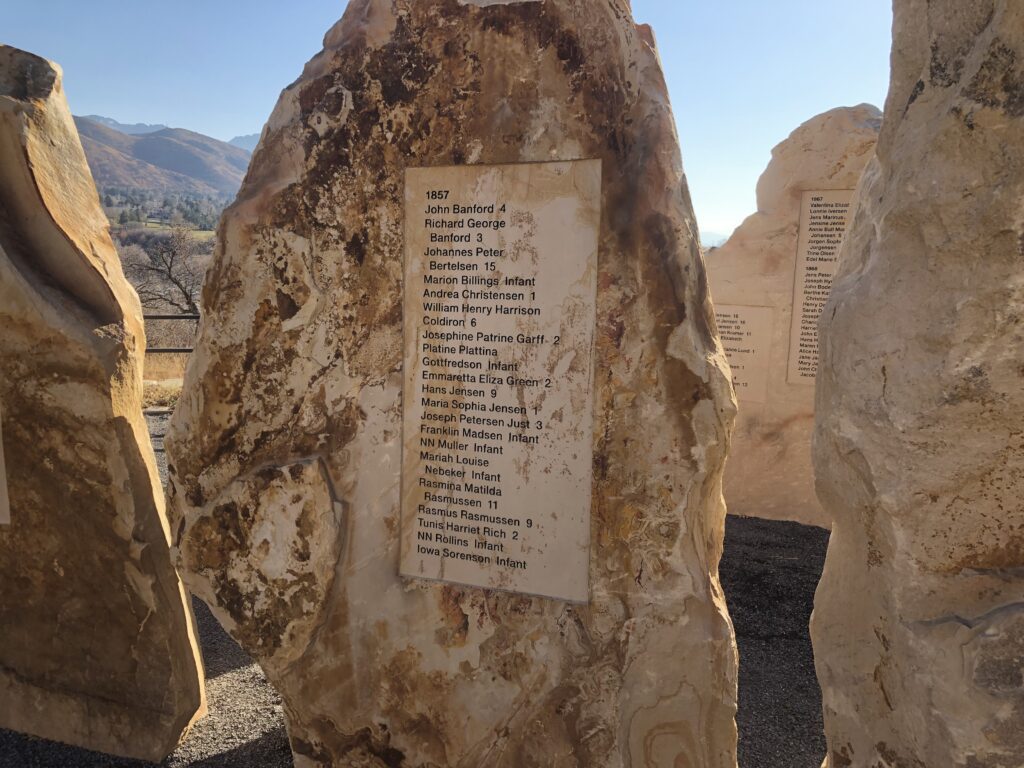
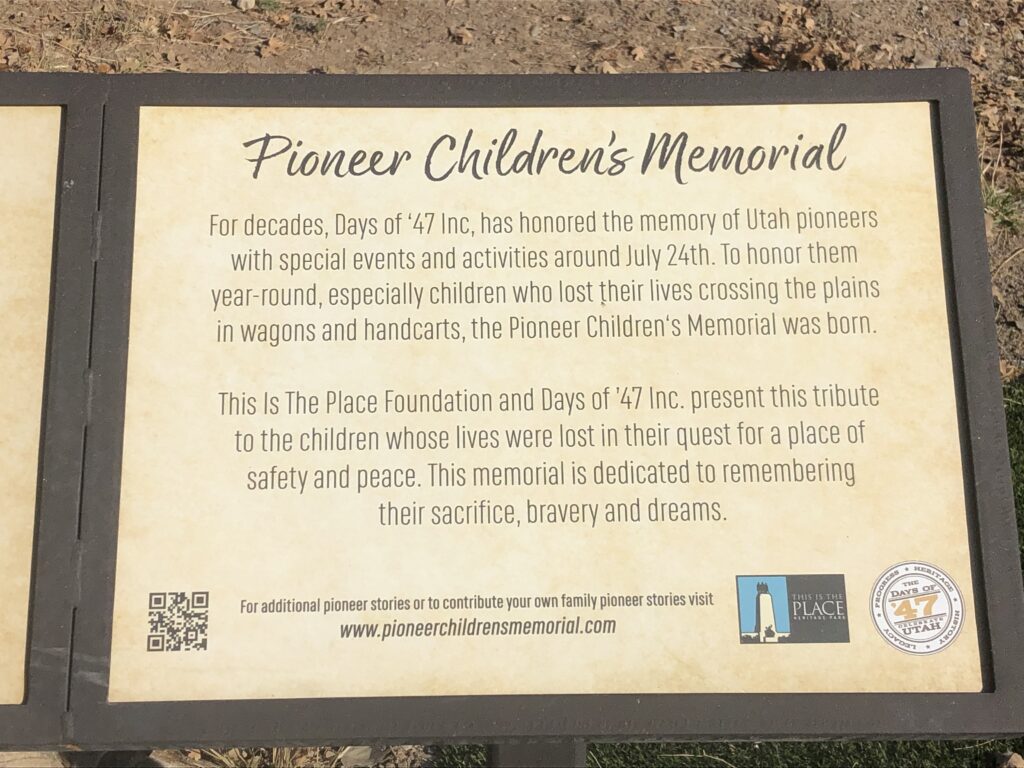
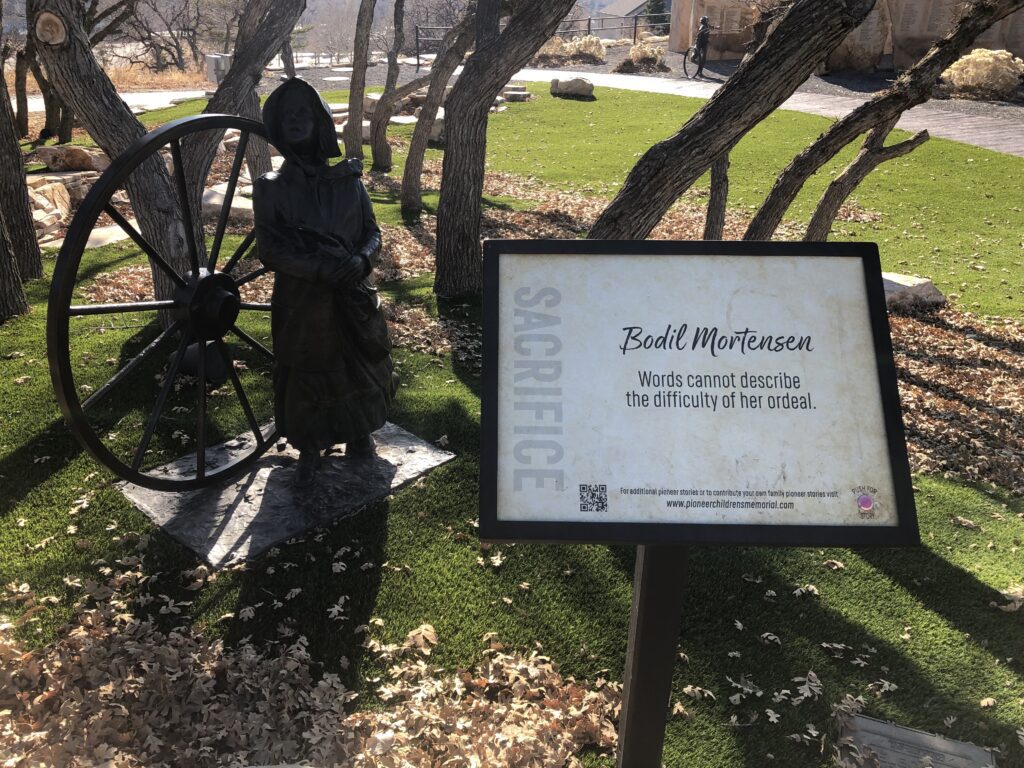
In the mid-1800s thousands of pioneer children walked/rode the 1,300 mile trail from Council Bluffs, Iowa to the Land of Zion in Utah. (The Pioneer Children’s Memorial website features several of these amazing stories. I highly recommend checking it out!)
Sadly, 684 children died along the trail. In 2019 a Pioneer’s Children’s Memorial was erected at This is the Place Heritage Park.
The names and ages of all 684 children are permanently engraved on 17 large memorial stones.
Native American Village
The Native American Village at This is the Place Heritage Park represents all 5 Native Utah tribes – Navajo, Piute, Ute, Goshute, and Shoshone. (Fun Fact – Utah was named after the Ute tribe!)
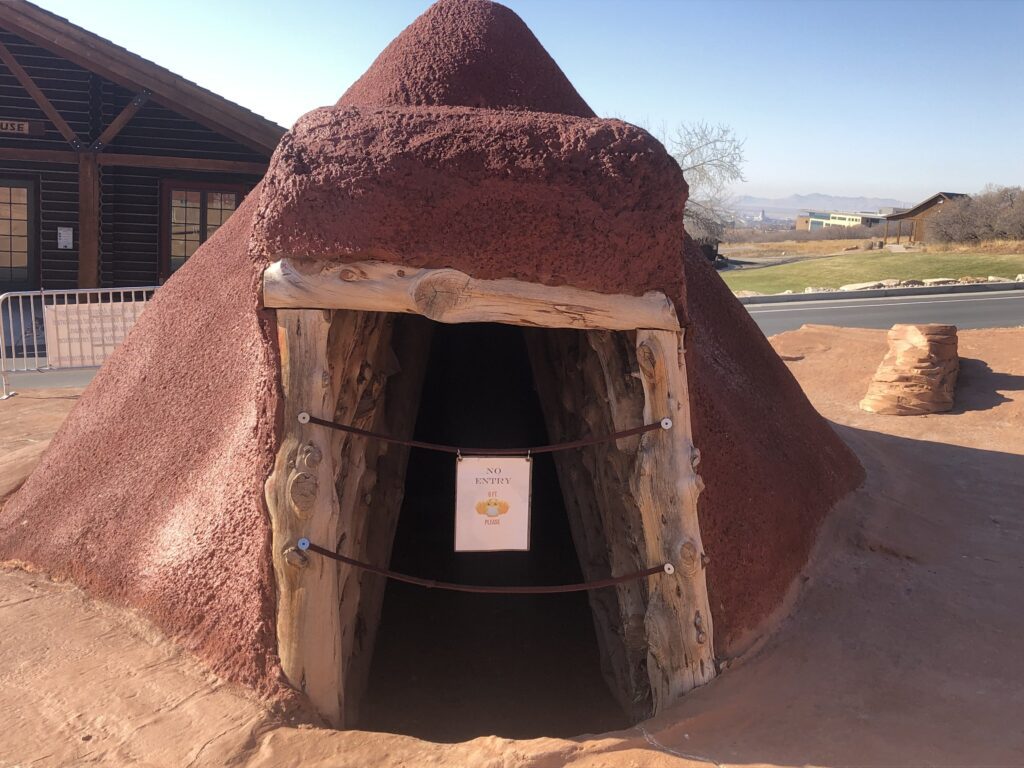
The village has a medicine wheel, Shoshone teepee, and Navajo male and female hogans.
On certain days visitors can grind corn, make arrowhead necklaces, and watch Native American dancers. Call ahead for the schedule.
Shoshone Teepee
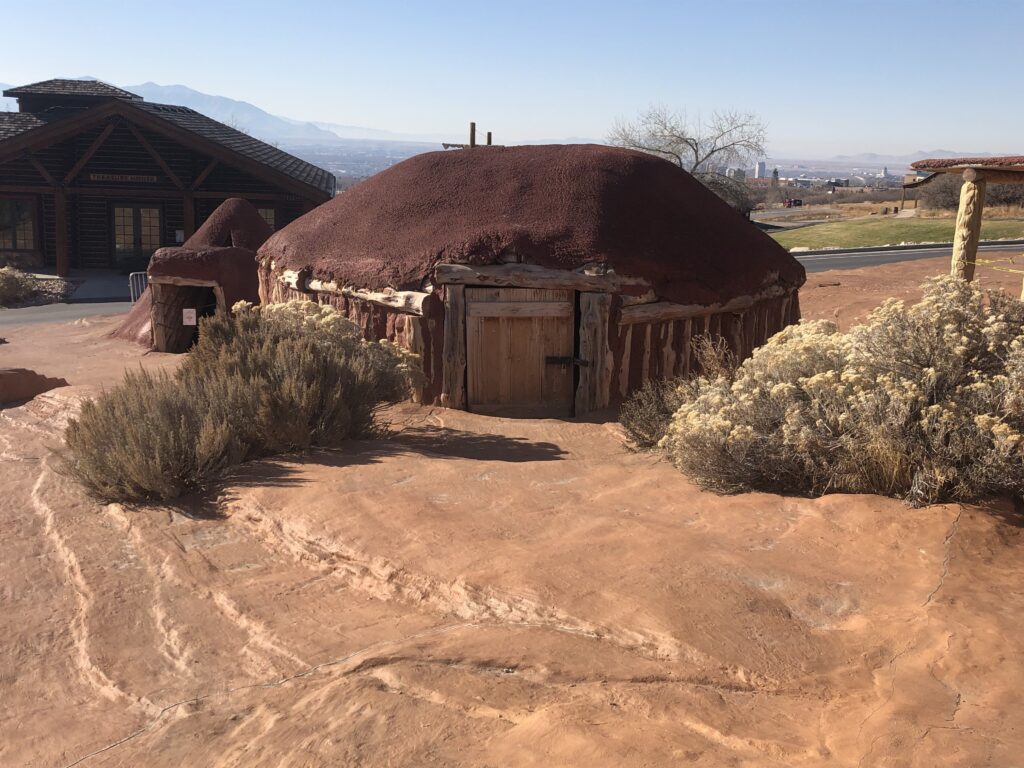
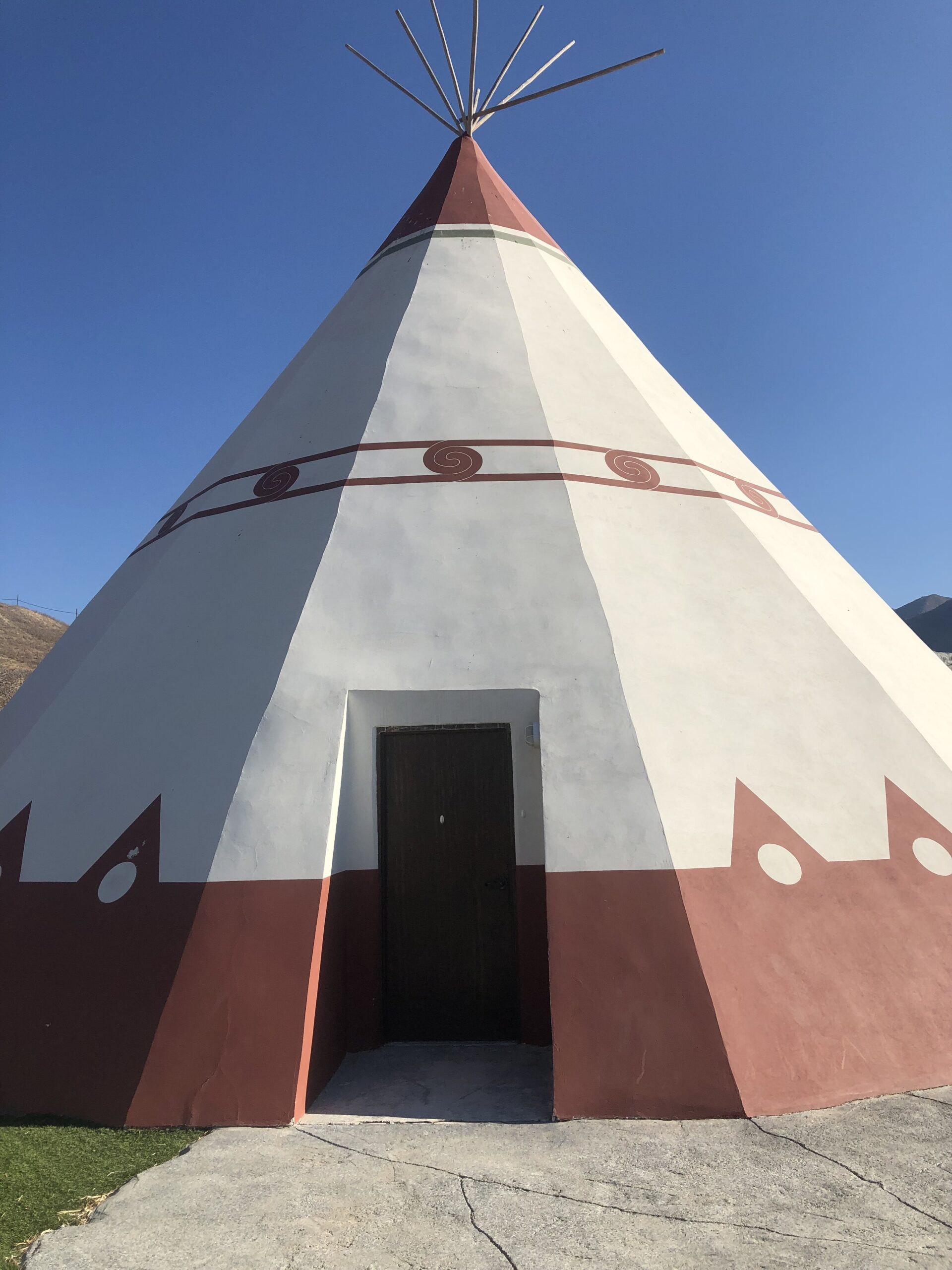
A highlight of the Native American Village is a large Shoshone teepee.
The word teepee means “to dwell in” in the Lakota language. Teepees were made out of animal skins and tree branches. They kept their occupants cool in the summer, warm in the winter, and dry when it rained.
Teepees were painted with designs inspired by the dreams and visions of their owners. They believed the paintings drove away evil spirits and brought protection.
Getting to the Teepee
I have been fascinated with Native American culture since I was a kid. When I planned my trip to Utah I could not wait to see the teepee at This is the Place Heritage Park.
In non-Covid times there is a small train that takes visitors around the perimeter of the park. When I visited the train was closed due to Covid, so I had to walk up an unbelievably steep hill.
When I finally got to the teepee to my horror I discovered that it was not an authentic teepee. Instead, it was made out of concrete! In non-covid times the entrance way to the teepee is open and visitors are allowed to enter.
Dining Options
There are several onsite dining options at the park. This includes snacks and drinks at the Visitor Center, Brigham’s Donuts at the donut shop, drinks and candy at the ZCMI candy shop, soft serve and flavor burst ice cream cones at the Huntsman Saloon, and lunch at the Huntsman Grill.
Check out the Huntsman Grill menu.
7. Utah State Capitol Building
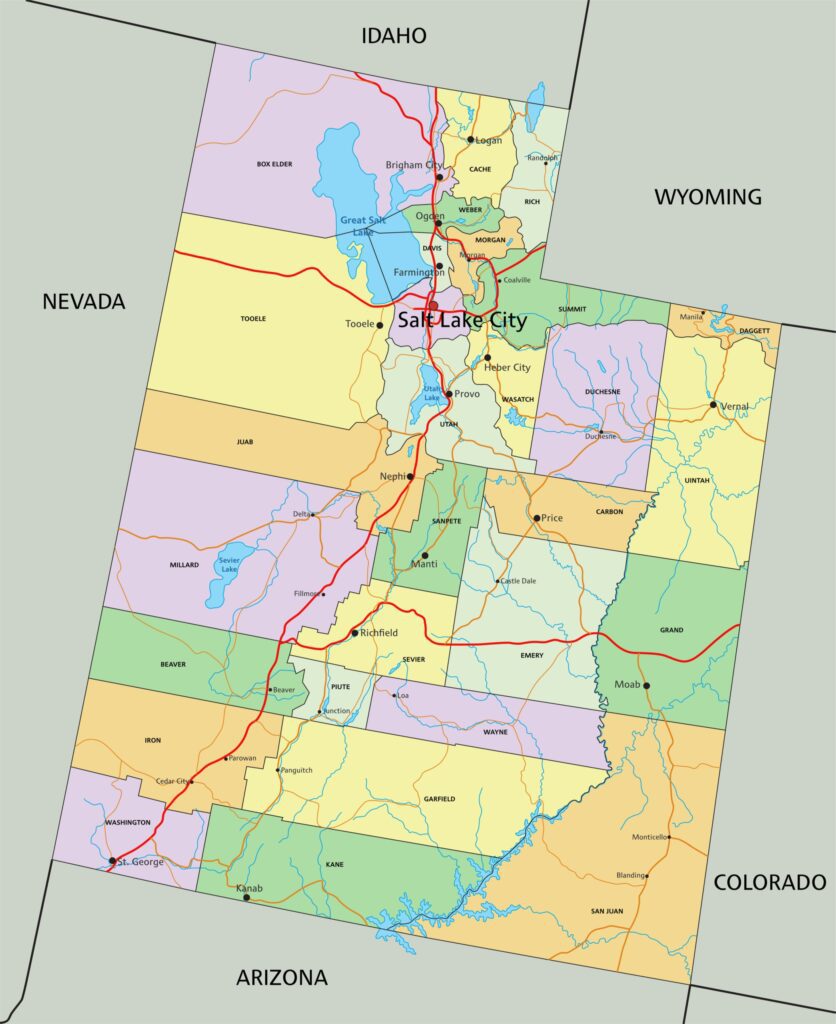
Utah became the 45th U.S. state on January 4, 1896. It is bordered by Idaho and Wyoming on the north, Colorado on the east, Arizona on the south, and Nevada on the west.
Utah State Capitol Building
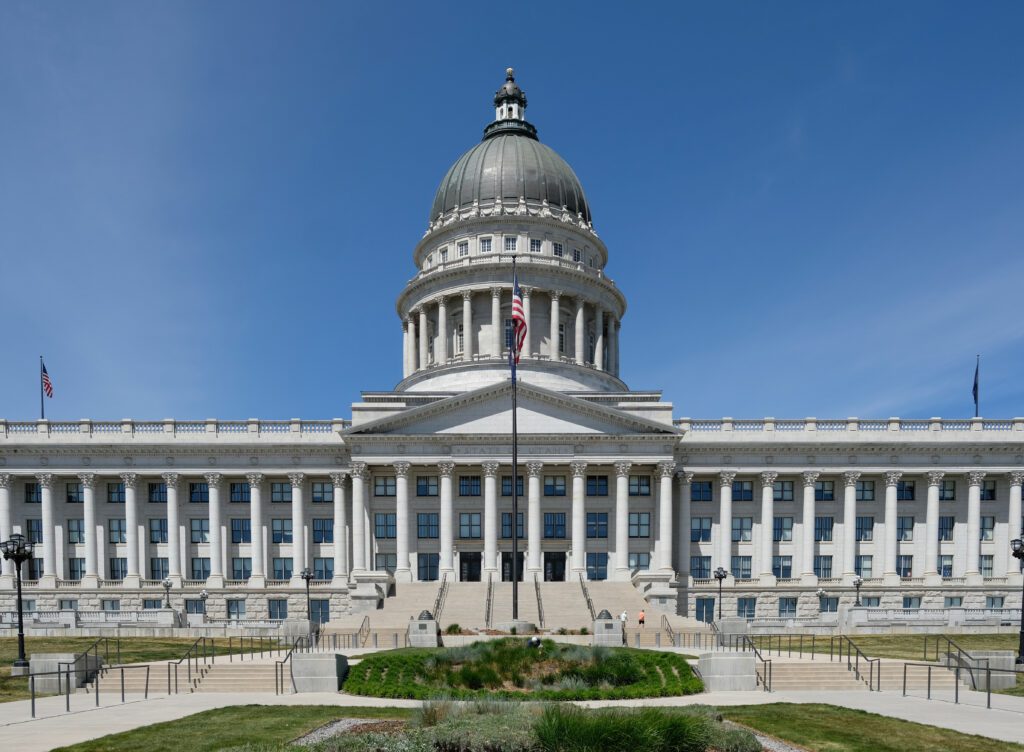
The Utah State Capitol building is a beautiful, neoclassical revival, Corinthian style building that looks like the Capitol Building in Washington D.C.
It houses the Utah State Legislature, Governor, and Lieutenant Governor.
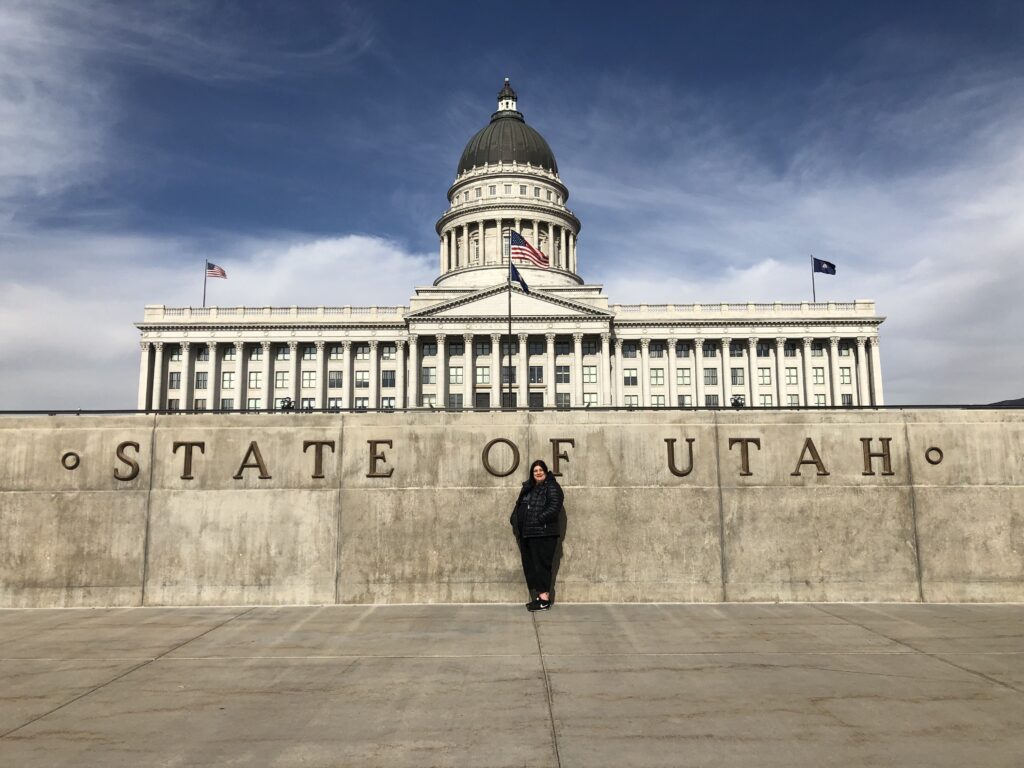
You can park in front and walk around the grounds. There is a stone wall in front that says “State of Utah” which is a great place to take pictures.
8. Great Salt Lake
Salt Lake City is named after the nearby Great Salt Lake. (It was originally named Great Salt Lake City, but the word “Great” was dropped in 1868).
Great Salt Lake is the remnant of the prehistoric Lake Bonneville which covered most of Utah, Nevada, and Idaho. Native Americans have lived in the area for over 10,000 years. Europeans did not discover the lake until 1824.
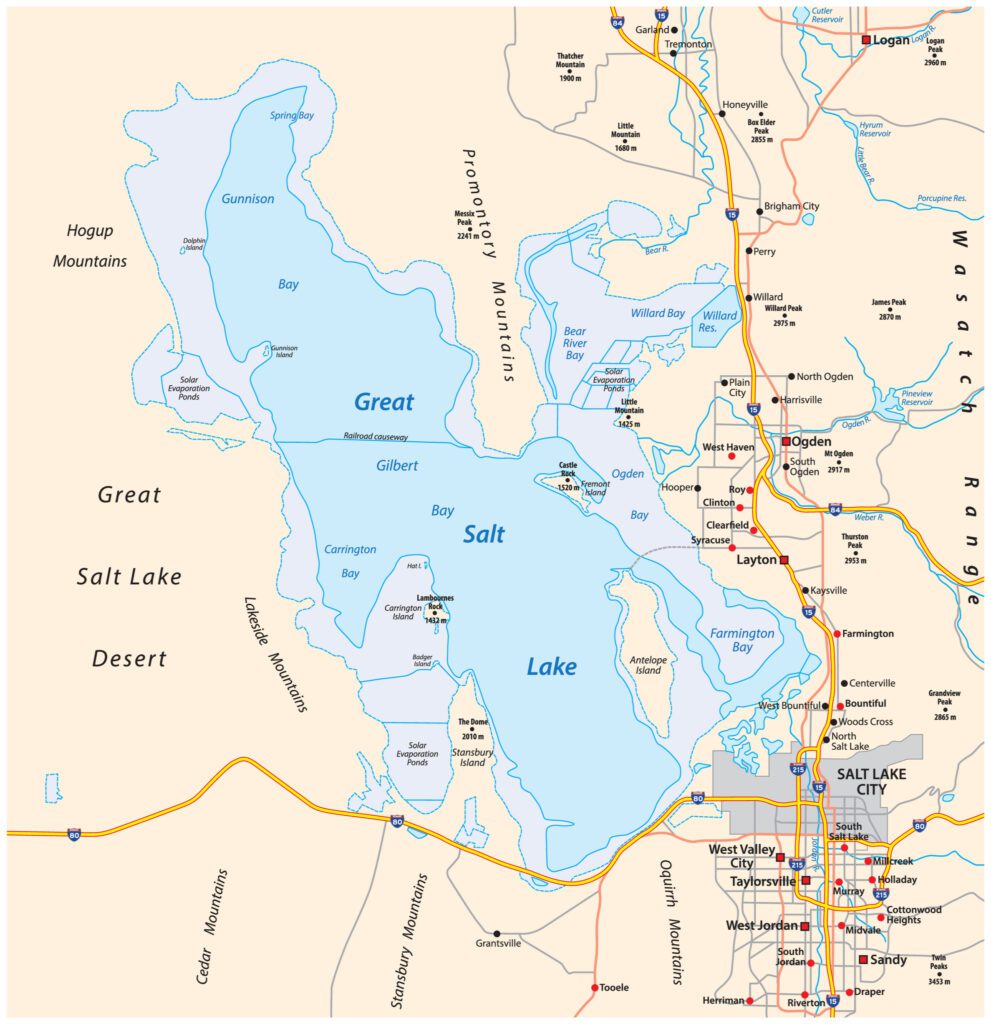
Great Salt Lake is the 6th largest lake in the U.S. after the 5 Great Lakes. It is 75 miles long and 35 miles wide.
Second Saltiest Body of Water
Great Salt Lake is the second saltiest body of water in the world! (After the Dead Sea in Israel/Jordan).
Great Salt Lake is saltier than the ocean! The lake is 6-25% salt, depending on the location. In contrast, the ocean is only 3.5% salt. Amazingly, the high salt content causes swimmers to float with no effort. (Which is why you always hear about people floating in the Dead Sea).
Great Salt Lake River Tributaries
There are 3 major rivers (Weber, Jordan and Bear) that pour fresh water into Great Salt Lake. (With melted snow from the nearby Wasatch mountains).
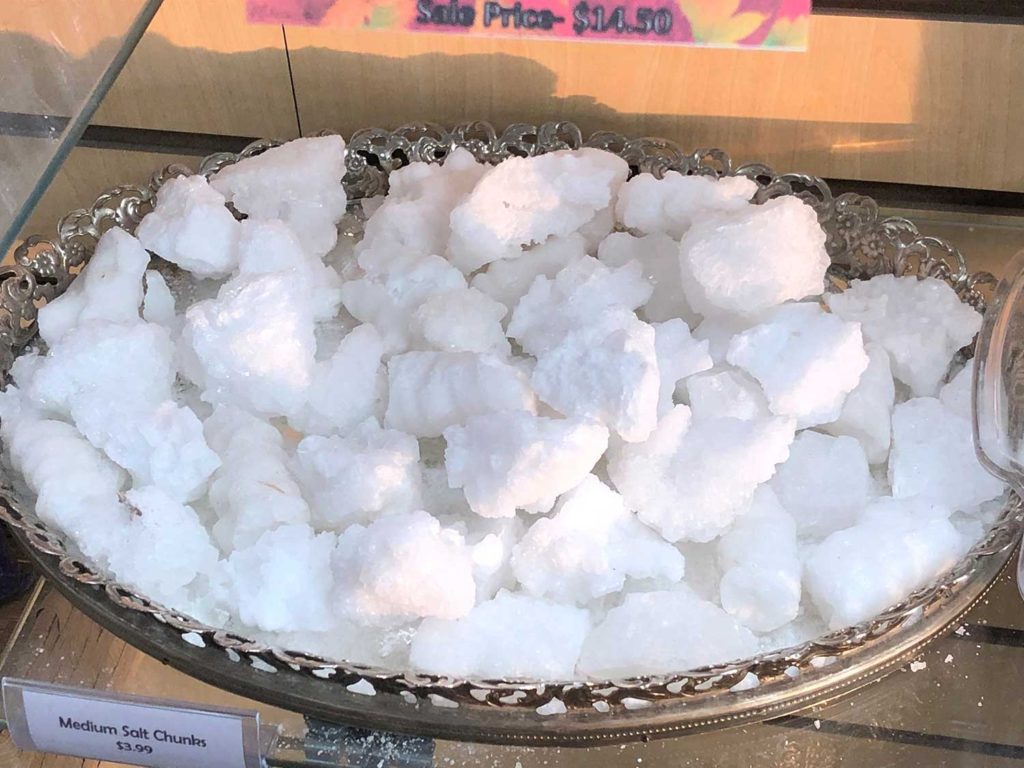
So why is the Great Salt Lake so salty? The answer is because it is a “terminal lake”; meaning it does not have any outlets. Therefore, the only way for water to escape is through evaporation; a process that leaves natural salts and minerals behind.
Incredibly, over the past 10,000 years over 4 billion tons of salt have accumulated in Great Salt Lake!!! In fact, several industries extract salt products from the lake. The 3 rivers replenish them.
Check out my blog Top Things To Do in Arches National Park!
Visiting Great Salt Lake
Great Salt Lake is a popular place for boating, kayaking and “swimming.” (Due to the high salt content, it would be ore accurately described as floating).
The water is so salty fish cannot live in the lake. Therefore, the only fishing spots are at the place where the rivers flow into the lake.
The only organisms that live in the Great Salt Lake are algae, bacteria, brine flies, and brine flies. Brine shrimp help the lake’s ecosystem by eating algae, which keeps the water clean. And they are a food source for migrating birds.
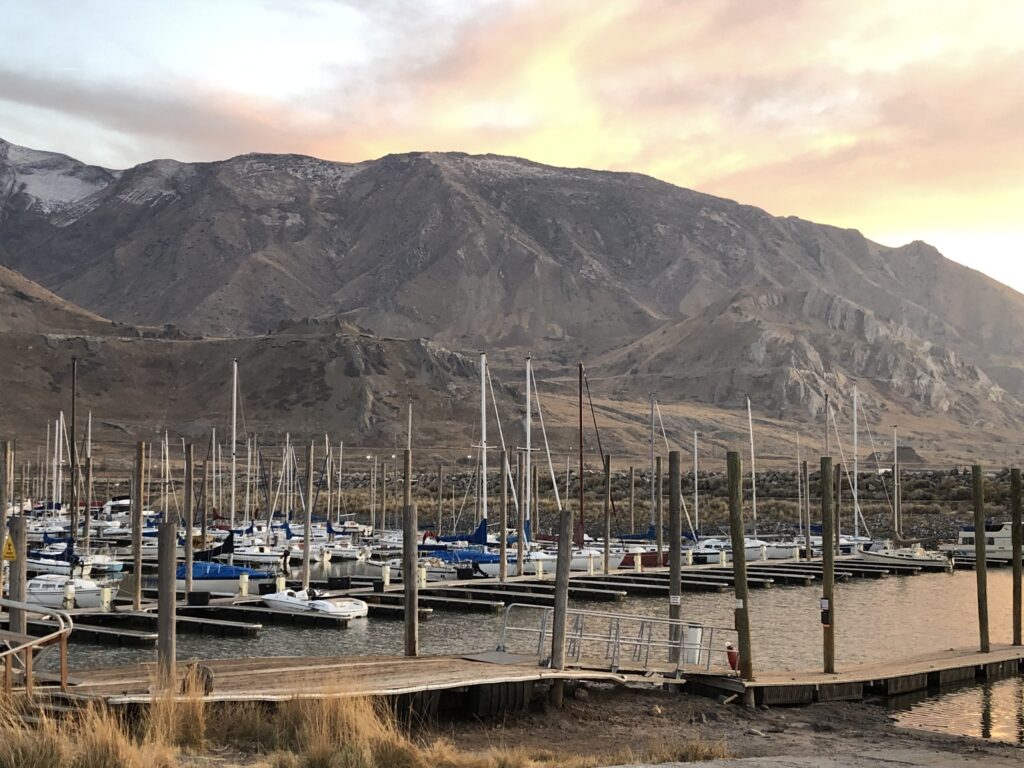
Great Salt Lake Marina
There are only a few places where the public can access the lake. Great Salt Lake Marina is 20 minutes from downtown Salt Lake City. It has a Visitor Center, swimming, boat dock, bathrooms, showers, and campgrounds.
Travel Tip: The museum at the Great Salt Lake Marina Visitor Center is really interesting. It is so small you can see everything in 10 minutes.
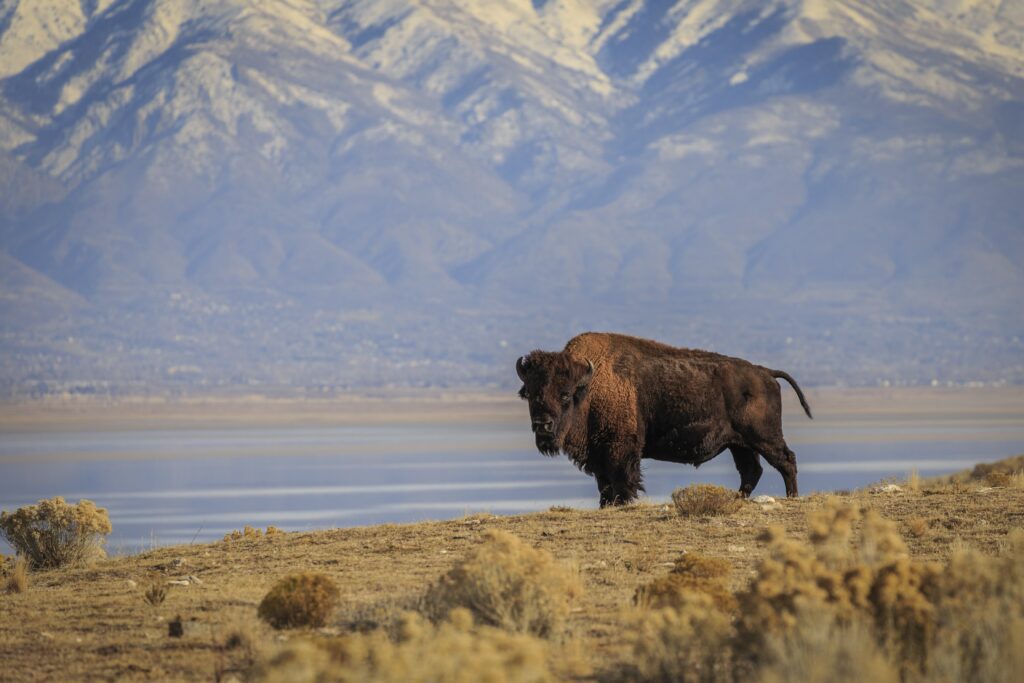
Antelope Island State Park
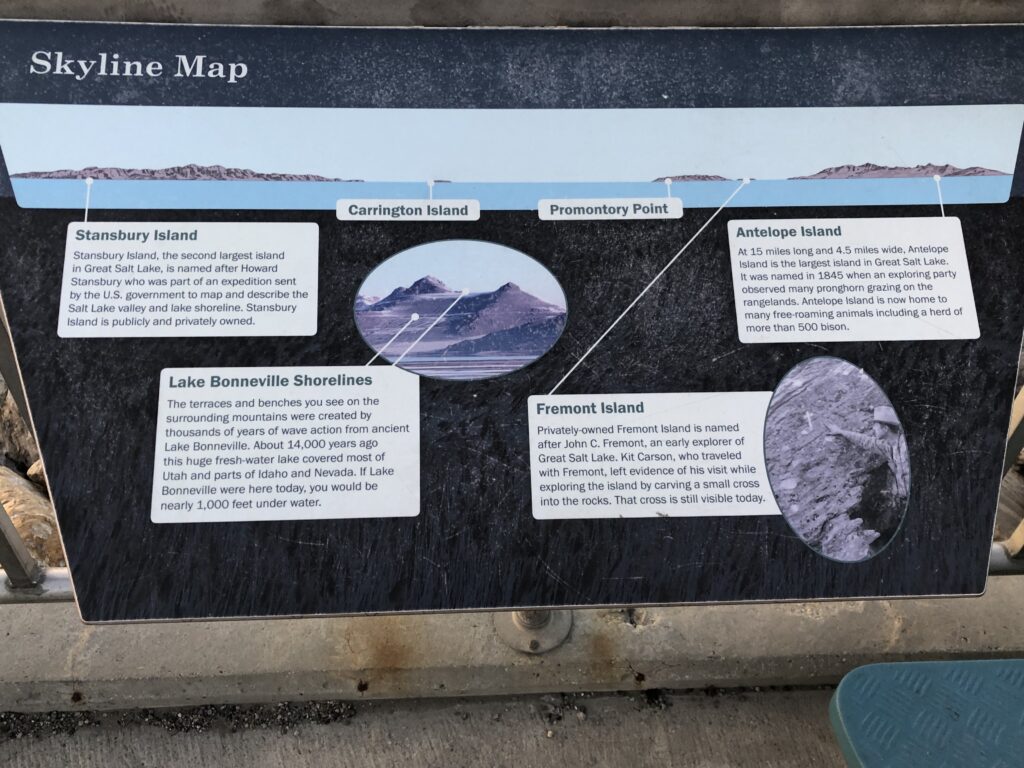
Antelope Island State Park is located on Antelope Island, one hour from downtown Salt Lake City. It is the largest of the 10 islands located on Great Salt Lake.
The park has white sand beaches, hiking and biking trails, a Visitor Center, swimming, bathrooms, showers, and campgrounds. Horseback riding is allowed and bike rentals are available. The Island Buffalo Grill Cafe is open from March 1st-November 1st.
The best place to experience the lake’s highly saline waters is Bridger Bay Beach. Restrooms and showers are available.
Antelope Island is home to wildlife including free-ranging bison, mule deer, bighorn sheep, coyotes, and of course antelope (pronghorns).
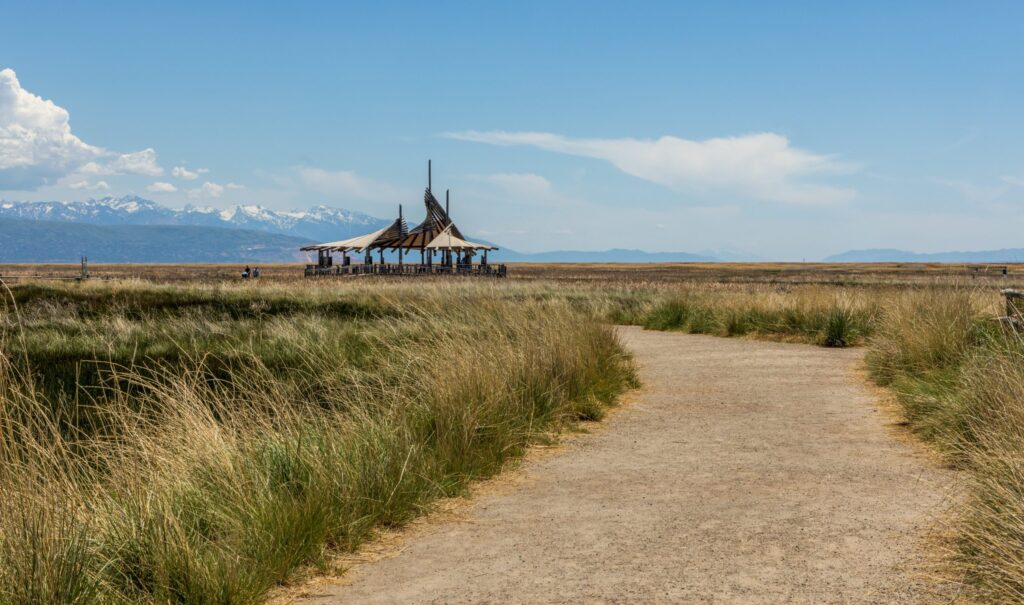
Great Salt Lake Shorelands Preserve
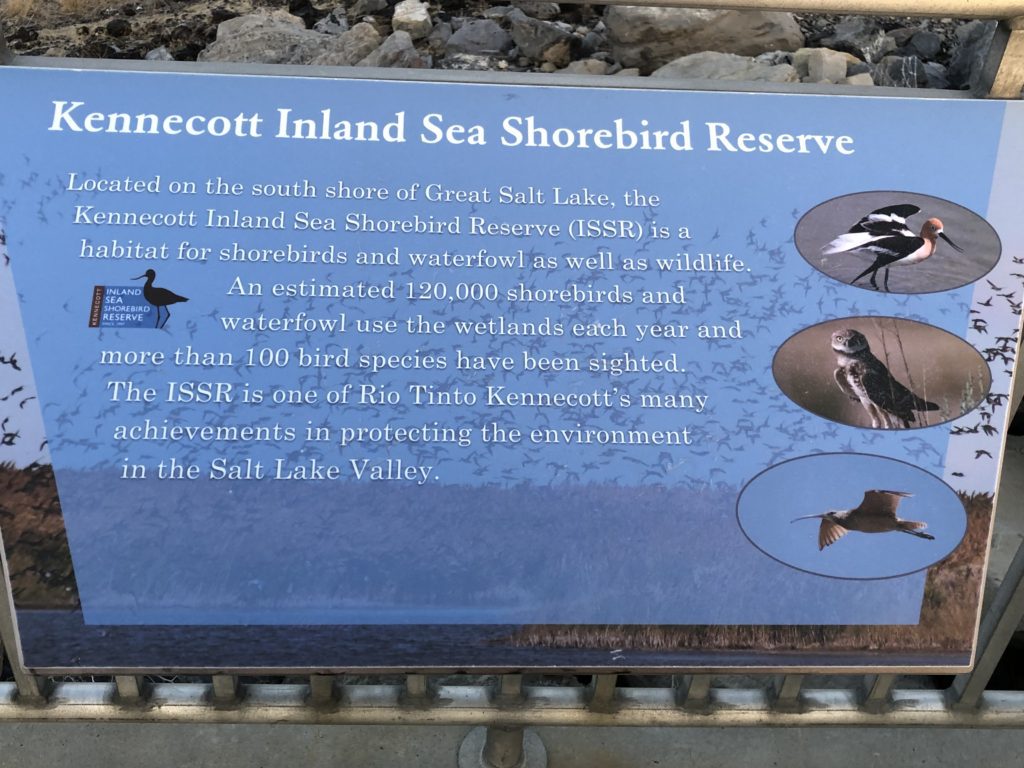
Great Salt Lake Shorelands Preserve is a 4,000 acre wetlands nature preserve on the eastern shore of Great Salt Lake. It is located on the north/south migration route for 4-6 million migratory birds who stop to nest and feast on the brine flies and shrimp.
The award-winning Great Salt Lake Shorelands Preserve Visitor Center feautures a one-mile wooden boardwalk trail over the water that includes a 30-foot viewing tower and 34 interpretive exhibits.
It is located between Farmington Bay Waterfowl Management Area and the Antelope Island State Park Causeway.
Birdwatching
Don’t forget to bring binoculars! The preserve’s visitor center is a birdwatcher’s paradise.
There are over 250 species of birds including Wilson’s phalarope, red-necked phalarope, American avocet, black-necked stilt, marbled godwit, Snowy Plover, western sandpiper, long-billed dowitcher, tundra swan, American white pelican, white-faced ibis, California gull, eared grebe, peregrine falcon, bald eagle, and various ducks and geese.
Travel Tip: Download the Audio Tour before your visit.
Check out my blog Top Things To Do in Bryce Canyon National Park!
Bonus – Salt Lake City Grid
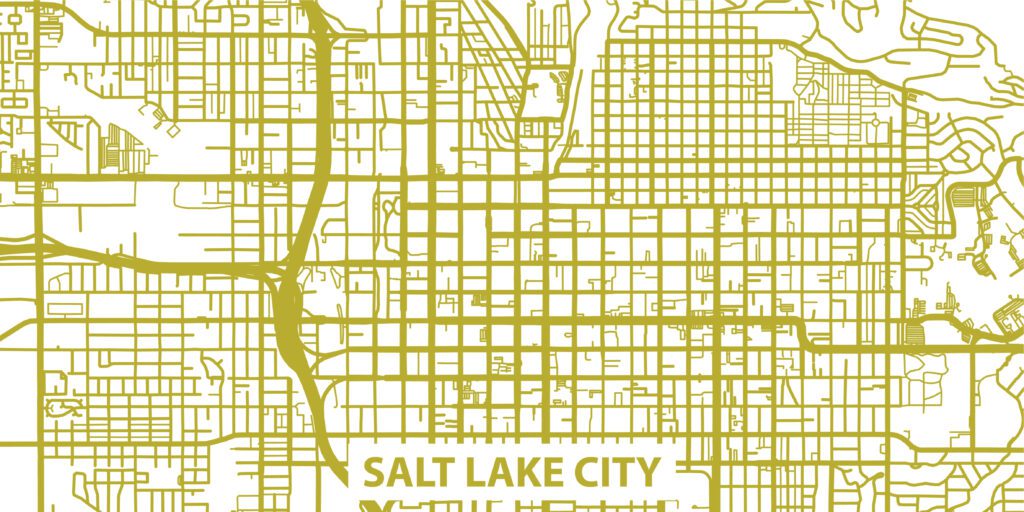
In order to navigate around Salt Lake City, you need to understand its grid system. Every address has TWO COORDINATES. For example, the address of the Sheraton Salt Lake City is 150 West 500 South.
The reason for this is because the city planners wanted the Salt Lake Temple to be the physical center of the city.
Base Line and Meridian
The southeast corner of Temple Square (South Temple Street and Main Street) is literally the city center. Its coordinates are 0 East, 0 West, 0 North, and 0 South.
The corner was used as the base line and meridian, which are imaginary lines used by surveyors to describe land. (The north-south line is the meridian, and the east-west line is the base line).
***All streets in Salt Lake City and the surrounding county are named according to their distance and direction from Temple Square.
Grid System used in every Utah City
Once you figure out the grid system it is actually very efficient. For example, if you are looking for 300 South and 500 East, you know that the location will be 3 blocks south and 5 blocks east of the center of town.
Amazingly, every city in Salt Lake COUNTY uses the southeast corner of Temple Square as their reference point.
So an address in Sandy, Utah will have large numbers such as 1400 East 12000 South. Theoretically, that means that the address is 1,400 blocks east and 12,000 blocks south of Temple Square. (Although I don’t know if that is 100% accurate).
The grid system is used in almost every city and town in Utah. They each have their own center.
Final Thoughts
Salt Lake City offers a unique blend of history, culture, and natural beauty, making it a must-visit destination. From the iconic Temple Square to the serene Great Salt Lake, there’s something for everyone.
The city’s rich Mormon heritage is showcased through attractions like the Tabernacle Choir and the Family History Library. Don’t miss the opportunity to experience its charm and beauty on your next adventure!
Check out my blog Top Things To Do in Zion National Park!